
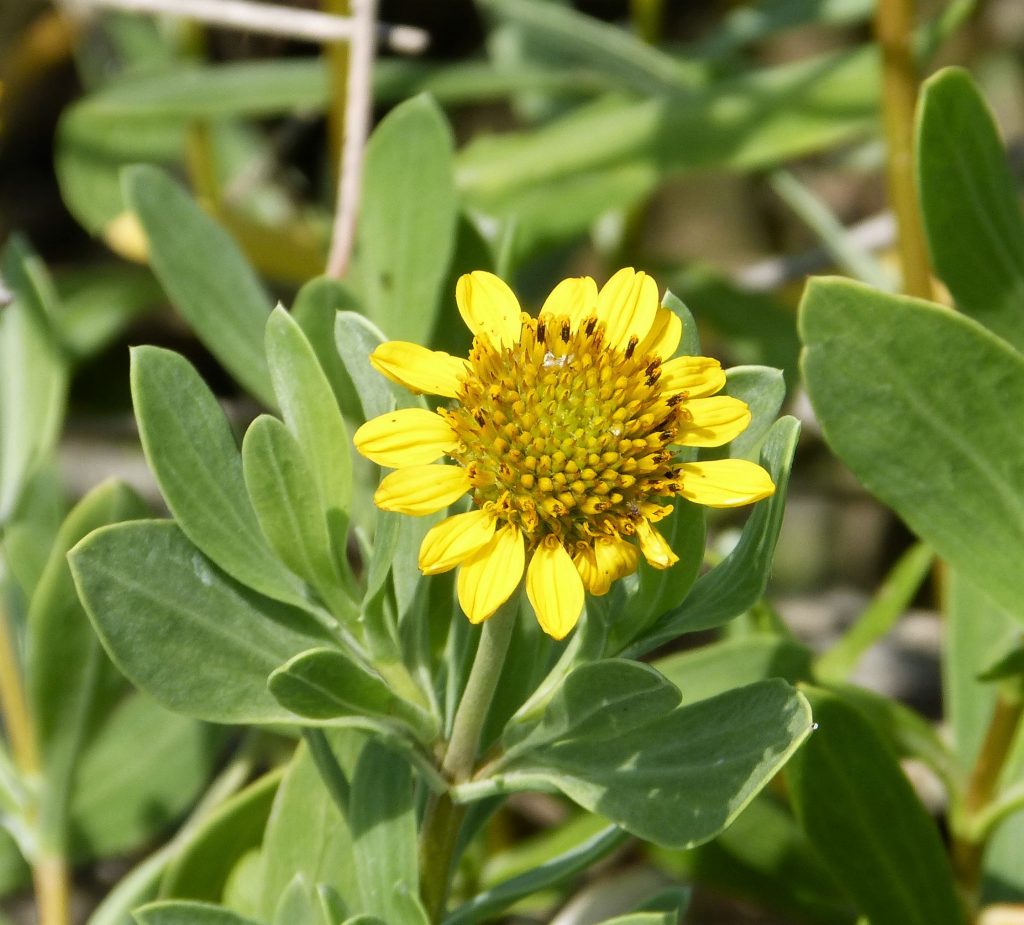
Also known as sea oxeye, bushy seaside tansy, and sea-marigold, this semi-evergreen shrub is native to North America where it grows in wetlands and on beaches of the Atlantic and Gulf coasts from Maryland south to Florida and west to Texas. It is a member of the aster family, Asteraceae, that also includes sunflower, yarrow, and lettuce. The plant grows 2-5′ tall and has gray-green to silvery, obovate leaves that are 2-4″ long, fleshy, and usually hairy. The leaf base usually has at least one spine. In spring and summer, all year in the southern part of its range, solitary flowerheads appear with spine-tipped phyllaries. The flowerhead is about 1″ wide and is composed of 15-30 short, yellow ray florets surrounding a center of many yellow-orange disc florets with black anthers. The inconspicuous fruits contain a single seed and are produced in spiny burr-like structures 1-3″ long. The flowers attract butterflies, the seeds provide food for birds and small mammals, and the foliage provides cover for wildlife. The plants spread by seed and rhizomes to form colonies and are are tolerant of moderate drought, salt spray, and occasional inundation with brackish water. They are useful as a groundcover or low hedge in seaside, native plant, wetland, wildflower, wildlife, and butterfly gardens. The genus name, Borrichia, honors Danish physician Ole Borch (1628–1690). The specific epithet, frutescens, may come from the Latin frutex meaning shrub and the suffix -ēscō meaning to become.
Type: Semi-evergreen shrub
Outstanding Feature: Flowers
Form: Spreading
Growth Rate: Slow to moderate
Bloom: Daisy like yellow flower heads in spring and summer, year around in warmer part of range
Size: 2-5′ H x 2-5′ or more W
Light: Full sun
Soil: Average-lean, wet to moist, well-drained to periodically inundated brackish soils
Hardiness: Zones 8-11
Care: Low maintenance
Pests and Diseases: None of significance
Propagation: Seed, cuttings, division
Photo Credit: gailhampshire Wikimedia Commons