
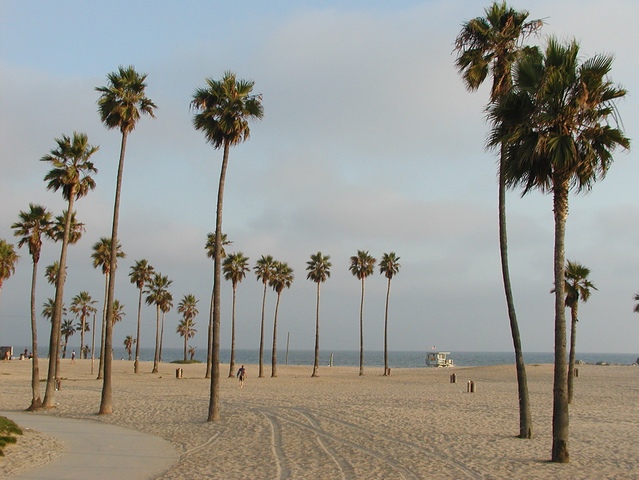
Also known as skyduster, this evergreen tree is native to the Baha California peninsula and a small part of Sonora in northwestern Mexico. It is a member of the palm family, Aracaceae, that also includes palmettos. Growing up to 98′ tall, the plant has a single, slender, unbranched reddish-brown trunk that weathers to gray and is wider at the base. Rich green fan-shaped leaves are carried atop the trunk on petioles that are up to 3’3″ long and are edged with with orange saw-toothed spines. Each leaf is 3-5′ long, divided halfway to the base, and has slightly drooping tips. The dead leaves remain on the tree, fold down, and form a skirt that may be a fire hazard. In early summer, drooping panicles appear that are up to 10′ long and carry slightly fragrant, cream to pinkish flowers about 1″ long. The flowers give way to an edible, spherical, blue-black drupes, 1/4-5/16″ in diameter. Mexican palm is tolerant of heat, humidity, drought, salt spray, and wind so is a good choice for coastal gardens as well as for a street tree. It looks best with tall structures because of its imposing height. The genus name, Washingtonia, honors the first president of the US, George Washington. The specific epithet, robusta, is the Latin word meaning strong.
Type: Evergreen tree
Outstanding Features: Foliage; height
Form: Rounded crown
Growth Rate: Rapid
Bloom: Long panicles of cream to pinkish flowers in early summer
Size: 40-98′ H x 8-10′ W
Light: Full sun
Soil: Average, medium moist to occasionally dry, well-drained; salt tolerant
Hardiness: Zones 9-11
Care: Remove dead leaves; fertilize 3 times a year to avoid potassium deficiency.
Pests and Diseases: Spider mites, scale, trunk rot
Propagation: Seed
Photo Credit: Wikipedia