
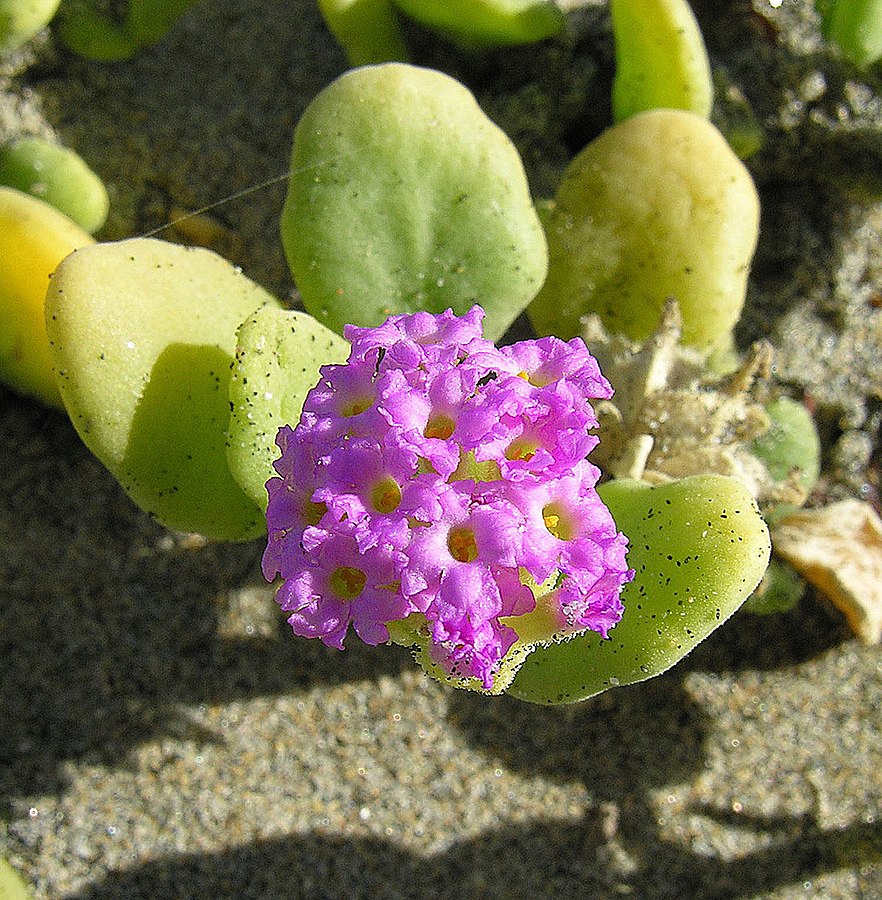
Growing on stable sand dunes of coastal Southern California, this native evergreen perennial is a member of the four o’clock family, Nyctaginaceae, that also includes bougainvillea. The plant grows up to 4.8″ tall and forms a thick mat of prostrate, branched ste that may be buried in the soil. Fleshy leaves on the stens are broadly elliptic to oblong and up to 2 1/2″ long. Throughout the year, clusters of 10-18 pink to red to purplish flowers appear that are attractive to bees. Red sand verbena does not grow in the ocean surf but requires saline water in the form of salt spray. It does not tolerate freshwater or prolonged drought. The foliage provides shelter for a variety of small beach-dwelling animals and the plant is a good choice for beach stabilization. The genus name, Abronia, comes from the Greek word abros, meaning delicate and refers to the bracts subtending the flower clusters. The specific epithet, maritima, comes from the Latin word mare, meaning sea, and refers to the favored habitat of the plant.
Type: Herbaceous perennial
Bloom: Clusters of 10-18 pink to red to purplish flowers throughout the year
Size: 4.8″ H x 1.6 – 6.41 W
Light: Full sun
Soil: Sand, free of organic matter; does not tolerate fresh water and depends on salt spray
Hardiness: Zones 10-11
Care: Low maintenance
Pests and Diseases: None of significance but susceptible to damage by human activity
Propagation: Seed
Companion Plants: Bush lupine (Lupinus chamissonis), black sage (Salvia mellifera), island wallflower (Erysimum insulare)
Photo Credit: Dick Culbert Wikimedia Commons