
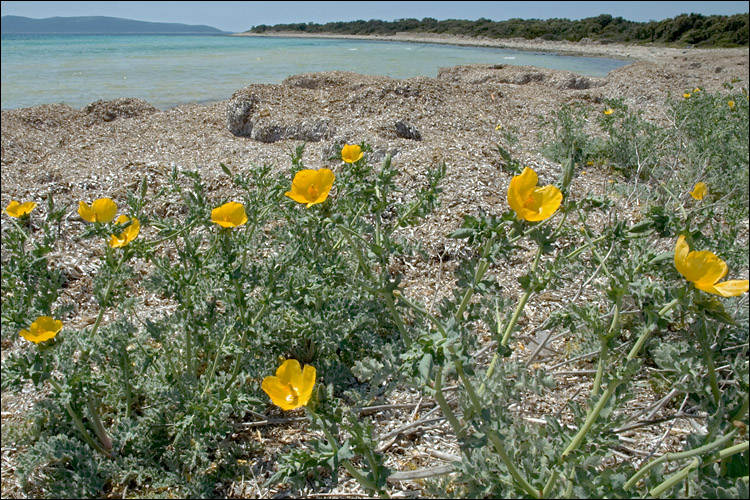
Also known as sea poppy, this short-lived herbaceous perennial is native to coastal habitats on shingle banks and beaches in temperate regions of North Africa, Europe and parts of Western Asia. It is a member of the poppy family, Papaveraceae, that also includes bleeding heart, bloodroot, and Corydalis. The plant forms a rosette of leathery, deeply segmented, bluish-gray leaves with wavy margins. In summer, 1-3′ tall branched stems carry bright yellow or orange flowers that are 2-3″ wide, have 4 silky 1″ wide petals, and are attractive to bees . The fruit is a long thin horned-shaped capsule 6-12″ long that ripens in late summer and is valued for use in dried arrangements. Yellow horned poppy is drought and salt tolerant so is an excellent choice for seaside gardens. All parts of the plant, especially the roots, are toxic. The genus name, Glaucium, comes from the Greek word γλαυκός (glaukós) meaning blue-gray and refers to the color of the leaves. The specific epithet, flavum, is the Latin word meaning golden yellow and refers to the color of the petals.
Type: Short-lived perennial
Bloom: Yellow to orange flowers 2-3″ across in summer
Size: 1-3′ H x 1-2′ W
Light: Full sun
Soil: Lean to average, dry, well-drained; tolerant of drought and salt
Hardiness: Zones 6-9
Care: Low maintenance
Pests and Diseases: None of significance
Propagation: Seed with cold stratification; plants readily self seed but resent transplanting
Companion Plants: Mexican feather grass, sea kale, Mexican daisy
Photo Credit: Dr. Amadej Trnkoczy Wikimedia Commons