
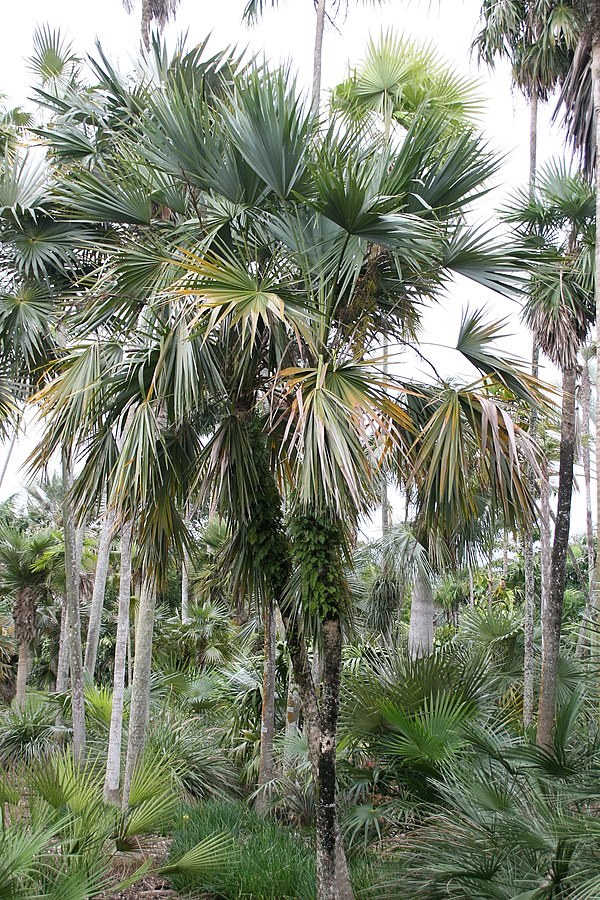
A member of the palm family, Arecaceae, this evergreen tree is native to the West Indies and Florida where it grows in open woodlands and coastal areas. The plant grows 2-36′ tall and has a solitary, smooth, brown or gray trunk and pale blue-green or yellow green, fan-shaped leaves with whitish undersides. The palmate leaves are 18-24″ long and carried on petioles .9-2.8′ long. The leaf blade is divided for at least half its length into lanceolate leaflets that are 1.1-2-3 ‘ long. In spring and summer, branched, arching Inflorescences appear that are 1.8-3.3’ long and extend well beyond the foliage. They carry white to yellow, fragrant flowers that are 1.4-1.2″ wide and give way to small white fruits turning yellow as they ripen. Thatch palm is highly tolerant of drought and salt spray, and can take occasional inundation. It is a good choice for containers and coastal gardens. The genus name, Thrinax, may come from the Greek word θρῖνᾰξ (thrînax), a three- pronged fork used to stir grain. The specific epithet honors Sir Daniel Morris, the early 20th century assistant director at the Royal Botanic Gardens, Kew.
Type: Evergreen tree
Outstanding Features: Foliage, fragrance
Form: Symmetrical, open crown
Growth Rate: Slow
Bloom: Branched, arching Inflorescences with many small white to yellow flowers from spring to summer
Size: 3-36′ H
Light: Full sun to part shade
Soil: Average, medium moist to dry, well-drained
Hardiness: Zones 10-11
Care: Low maintenance
Pests and Diseases: None of significance
Propagation: Seed
Photo Credit: David J. Stang Wikimedia Commons