
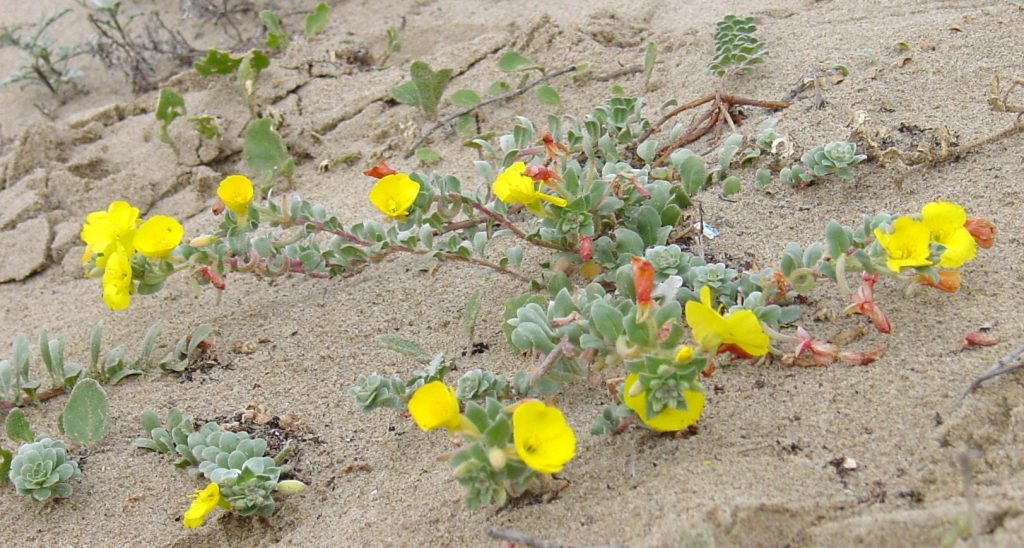
Also called suncup, this short-lived herbaceous perennial is native to open dunes and sandy soils of coastal California, Baha California and Oregon. It is a member of the evening primrose family, Onagraceae, that also includes fuchsia, Gaura, and Clarkia. The plant grows 3-4′ tall from a deep tap root and has a central crown with prostrate stems that form mats up to 36″ wide. The silvery gray-green leaves are obviate to oblanceolate, up to 3′ long, have smooth margins, and often lack petioles. From early spring to mid-summer, flowers with 4 fan-shaped petals appear in the leaf axils. The flowers are 1-1.5″ wide, bright yellow fading to reddish, and open in the morning. They are attractive to butterflies and give way to 4-sided slim fruits that persist after splitting open and dispersing seeds. Beach evening primrose is a tough plant and can tolerate wind, high temperatures, salt spray, drought, and shifting substrate so is an excellent choice for dune restoration and seaside gardens. The origin of the genus name, Camissoniopsis honors Ludolf Karl Adelbert von Chamisso (1781-1838) a French born German botanist, post and explorer. the suffix -opsis is from the Ancient Greek word opsis (ὄψις) meaning appearance and refers to the resemblance of the genus Camissonia (suncups). The specific epithet, cheiranthifolia, is from the old genus name for wallflower, Cheiranthus, and the Latin word folia, meaning leaf, referring to the resemblance of the leaf to that of the wallflower.
Type: Short-lived herbaceous perennial
Bloom: Bright yellow flowers fading to reddish from early spring to mid summer
Size: 3-4″ H x 6-36″ W
Light: Full sun
Soil: Sandy, dry, well-drained; drought and salt tolerant
Hardiness: Zones 8-10
Care: Low maintenance
Pests and Diseases: None of significance
Propagation: Seed
Companion Plants: Sand verbena (Abronia latifolia), seaside daisy, bluff lettuce
Photo Credit: Wikipedia
 Karen Meyers