
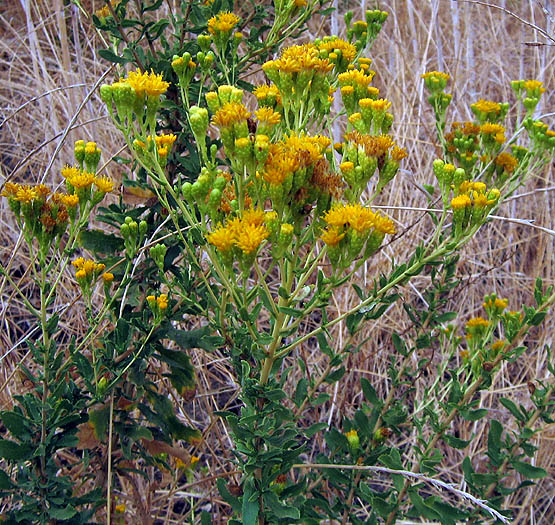
This semi evergreen subshrub is native to sandy soils of California, Baja California, and Baha California Sur where it grows in areas such as coastal strand and coastal sage scrub. It is a member of the aster family, Asteraceae, that also includes sunflower, goldenrod, and lettuce. The plant grows 3-4′ tall and forms a matted bush with several main stems that grow from a wood base. The stems are branched at the base and are glandular, hairless to woolly, and vary from gray-green to reddish brown. Obovate, gray-green leaves with smooth to toothed margins are clustered along the stem They are up to 2″ long and are sometimes hairy and glandular. From spring to early winter, clusters of flowerheads appear. Each head has 3-6 rows of pointed, spine-tipped green phyllaries surrounding a center of 6-50 yellow disc florets with long protruding stigmas. The flowers are a nectar source for butterflies and bees. The tiny single-seeded fruit has a pappus twice its length that aids is dispersal. Menzies’ goldenbush is drought tolerant, and its flowers are a nectar source for butterflies and bees. It is valued for stabilizing sandy soils and for use in coastal, native plant, wildlife, butterfly, bee, pollinator, and rock gardens. The genus name, Isocoma, comes from the Greek isos, meaning equal, and kome, meaing hair of the head, and may refer either to the length of the pappus bristles or the flowers. The specific epithet, menziexii, honors Archibald Menzies (1754 –1842) Scottish surgeon, botanist, and naturalist.
Type: Semi evergreen subshrub
Outstanding Feature: Flowers; drought tolerance
Form: Rounded
Growth Rate: Slow
Bloom: Yellow flowerheads with protruding stamens from spring to late fall
Size: 1.6 – 3.3′ H x 5″ W
Light: Part shade to full sun
Soil: Sandy, dry to medium moist, well-drained
Hardiness: Zones 9+
Care: Low maintenance
Pests and Diseases: None of significance
Propagation: Seed
Outstanding Selections: At least 6 varieties have been identified
Photo Credit: Anthony Valois Wikimedia Commons