
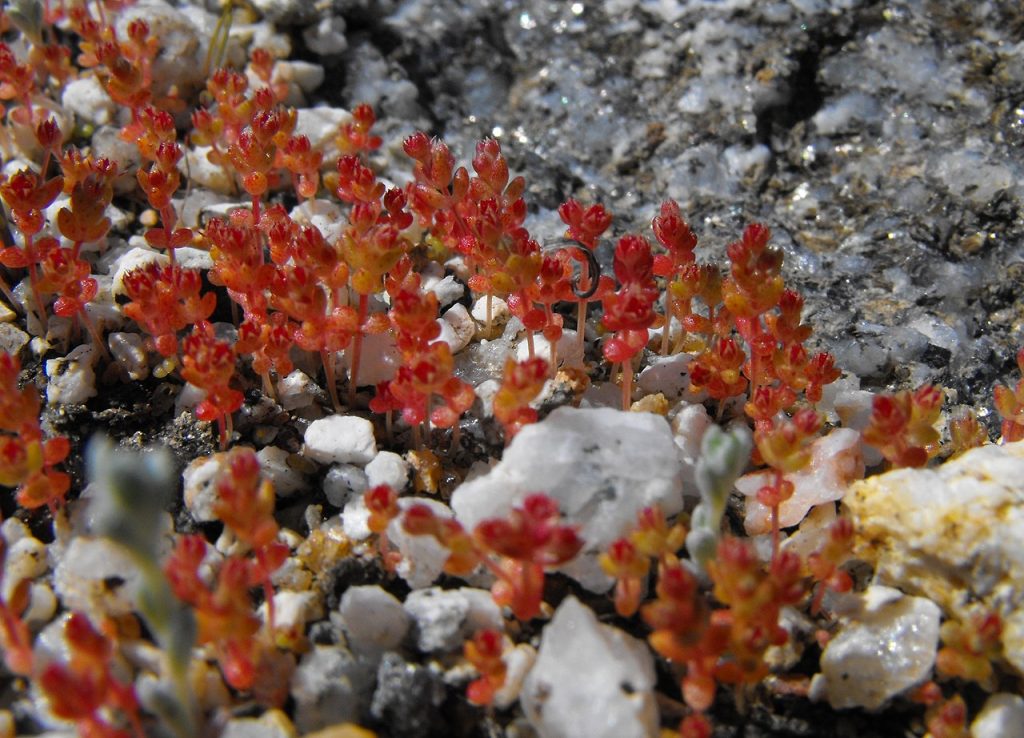
Also known as pigmy weed, this annual succulent is native to western North America from British Columbia to Mexico and parts of Central and South America where it prefers open, rocky, moist sites. It is a member of the stonecrop family, Crassulaceae, that also includes jade plant, hen and chicks, and Aeonium. The plant is up to 2.5″ tall and grows like moss on rocks or small patches of ground in spring. It has branched or unbranched stems that are .8-2.4″ long, green when young but becoming red with maturity. The fleshy, leaves are oval to obovate, up to 1/8″ long, and have one or more glands on their underside that appear as red dots. The flowers appear in the leaf axils and are about 3/64″ across. They have 4 fleshy light green sepals that often have rose-colored spots, and 4 non-fleshy, colorless to whitish petals. The boat-shaped fruits contain 1-2 tiny brown seeds. Pigmy stonecrop has little ornamental value but is a unique and interesting plant. The genus name, Crassula, comes from from the Latin word crassus, meaning thick and refers to the succulent leaves. The specific epithet, connata, comes from the Latin com/n-, meaning together, and natus, meaning born, and refers to parts being fused together.
Type: Annual succulent
Bloom: Tiny, inconspicuous flowers in spring
Size: 2.5″ H
Light: Full sun
Soil: Rocky to sandy, moist, well-drained
Hardiness: Zones 8-10
Care: Low maintenance
Pests and Diseases: Mealy bugs
Propagation: Seed
Companion Plants: Dudleya blochmaniae, Pterostegia drymarioides, Selaginella sp, Dodecatheon clevelandii
Photo Credit: Stickpen Wikimedia Commons