
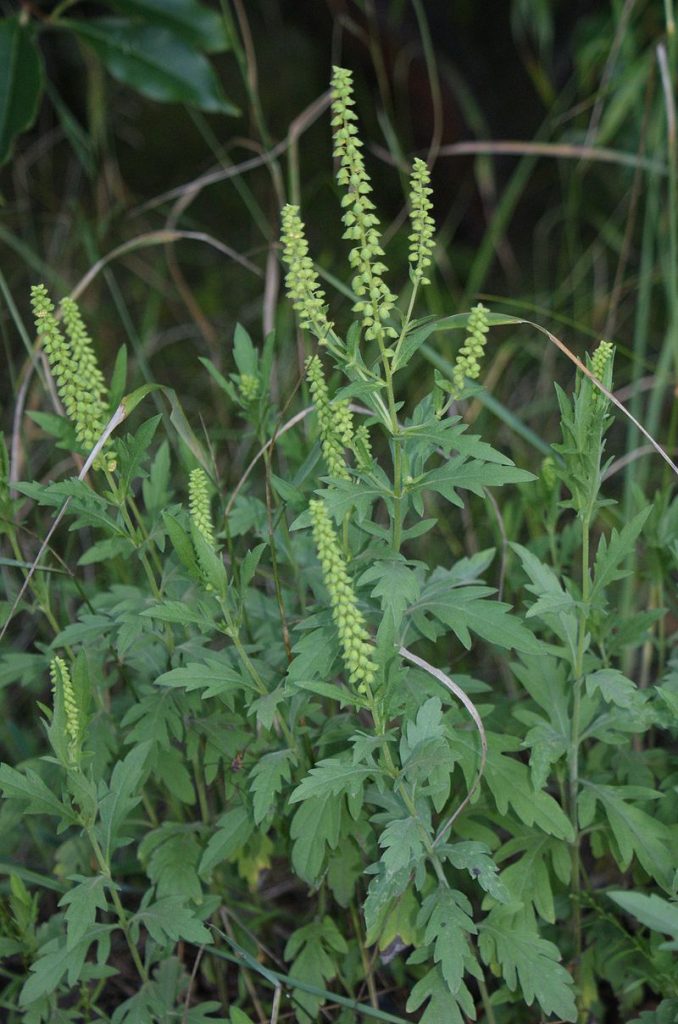
Also called bur-sage, burr-ragweed, and Cuman ragweed, this herbaceous perennial is native to most of the North America. It is a member of the aster family, Asteraceae, that also includes sunflower, yarrow, and lettuce. The plant grows 1-7′ tall and has a fibrous and rhizomatous root system, and pale-green to straw-colored stems. The grayish-green or whitish-green, oval to lanceolate leaves are up to 5″ long and pinnately divided into many narrow and pointed lobes that may be further divided. Both the leaves and stems are hairy. From mid summer to fall, 1-6″ long spikes of greenish male and female flowerheads appear on the same plant. Numerous tiny, nodding male flowerheads containing 5-10 florets are located above the solitary to few, female flowerheads that are subtended by large leaf-like bracts and located along the stem or in the leaf axils. The dry, one-seeded fruit is up to 1/8′ long and enclosed in a hairy, sometimes spiny, greenish-brown burr. Although western ragweed is an important food for wildlife and has been used in grassland reclamation projects as well as in traditional medicine by native Americans, the plant is generally considered a weed and responsible for causing allergic reactions in susceptible individuals so is not suitable for most gardens. The genus name, Ambrosia, is from the ancient Greek word ἀμβροσία (ambrosía) meaning immortality. The specific epithet, psilostachya, may come from the ancient Greek words ψιλός (psilos) meaning bare, and σταχυς (stachys), meaning an ear of grain, referring to the inflorescence.
Type: Herbaceous perennial
Bloom: Inconspicuous male and female flowerheads on the same plant from mid summer to fall
Size: 1-7′ H x 1′ W
Light: Full sun
Soil: Lean to average, medium moist to dry , well-drained
Hardiness: Zones 6-10
Care: Low maintenance
Pests and Diseases: None of significance
Propagation: Seed, division
Companion Plants: Little bluestem grass, thread leaf sedge, fragrant sumac
Photo Credit: Krzysztof Ziarnek Kenraiz Wikimedia Commons