
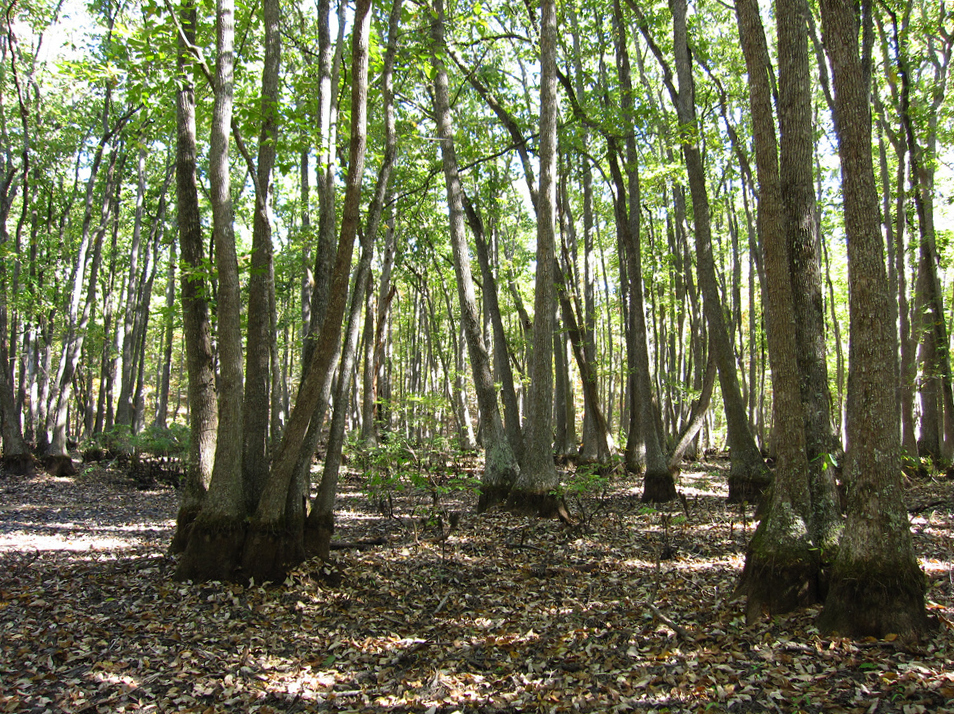
Also known as water gum and swamp black gum, this deciduous tree is native to coastal plains from Delaware, eastern Maryland, and southeastern Virginia, south to southern Florida and west to eastern Texas, north up the Mississippi Valley to southern Arkansas and west and south Tennessee where it grows in wetland habitat such as swamps and estuaries. It is a member of the dogwood family, Cornaceae, that also includes handkerchief tree. Trees grow up to 100′ tall from a taproot and have a straight trunk that is buttressed or flared at the bottom and has grayish-brown, irregularly ridged or furrowed bark. Top branches are usually spreading or slightly drooping. The simple, leathery leaves are elliptical or narrowly obovate, 3-6″ long and provide red to burgundy coloration in fall. The inconspicuous pale-green flowers appear slightly later than the leaves and may be male, female or bisexual. The male flowers appear in loose racemes of 2-8, while female and bisexual flowers appear as bracted pair at the end of a long axillary stalk. The female and bisexual flowers are pollinated primarily by bees and give way to an ellipsoid drupe about 1/2″ long that is blackish when mature and attractive to birds and small mammals. Although not used extensively as a garden tree, swamp tupelo’s colorful foliage and tolerance of wet soil make it a good choice for native plant, wildlife, pollinator, woodland, and rain garden. The genus name, Nyssa, honors the mountainous district of Nysa (Νῦσα) in Greek mythology where the rain nymphs, the Hyades, raised the infant god Dionysus. The specific epithet, biflora, is from the Latin bis meaning two, and flora, meaning flower.
Type: Deciduous tree
Outstanding Feature: Likes wet sites; fall foliage
Form: Trunk swollen at the base, crown narrow
Growth Rate: Slow
Bloom: Inconspicuous pale green male, female, or bisexual flowers on the same tree in spring
Size: 60-100′ H
Light: Full sun to partial shade
Soil: Average, moist, acidic; benefits from continuously saturation with very shallow moving water
Hardiness: Zones 7-9
Care: Low maintenance
Pests and Diseases: Tupelo leaf miner (Antispila nyssaefoliella), forest tent caterpillar (Malacosoma disstria), scale , canker, leaf spots, rust
Propagation: Seed
Outstanding Selections: None available
Photo Credit: Chris M Wikipedia
 Karen Meyers