
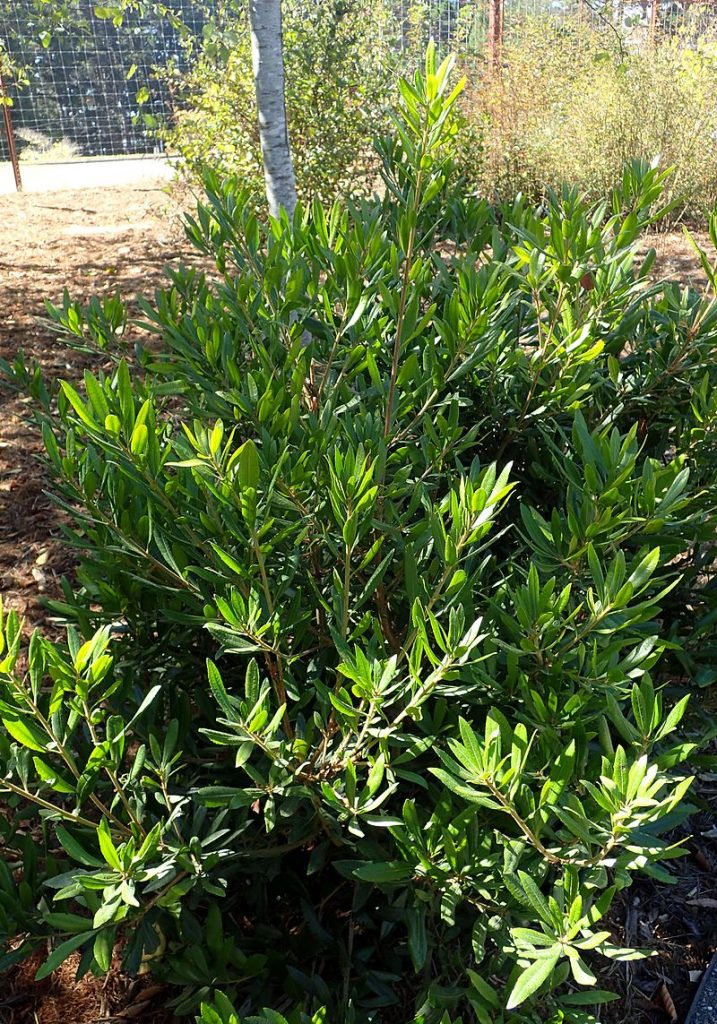
Also known as Pacific wax myrtle, California wax myrtle or California bayberry, this evergreen shrub or small tree is native to the West coast from Los Angeles to British Columbia where it grows on dunes, hills and in woodlands. It is a member of the Myricaceae, a small family of shrubs and trees that also includes sweetfern. Growing up to 33′ tall, the plant has nitrogen fixing microorganisms in its root nodules. The lanceolate, glossy, dark green leaves densely clothe the numerous stems and are l.5-5″ long with serrated margins. In spring, inconspicuous yellow-green to red male and female catkins appear on the same or different plants. In late summer female catkins give way to wrinkled, purple tiny berries that have a waxy coating, persist into winter and are attractive to birds. Very easy to grow, California wax myrtle is tolerant of lean soil, drought once established, and salt spray so is an excellent choice for coastal gardens. In addition, it takes well to pruning and can be used as a hedge, windbreak, screen, or specimen plant. The genus name, Myrica, is from the ancient Greek word μυρίκη (muríkē) meaning tamarisk. The specific epithet, californica, is the Latinized form of California and refers to one of the states where the plant is native.
Type: Evergreen shrub or small tree
Outstanding Feature: Foliage
Form: Upright
Growth Rate: Rapid
Bloom: Yellow-green to red, inconspicuous catkins of male and female flowers on the same or different plants in summer
Size: 10-33′ H
Light: Sun to partial shade
Soil: Sandy to clay, dry to moist, well-drained, slightly acid; tolerates lean soil, drought once established, and salt spray
Hardiness: Zones 7-10
Care: Low maintenance
Pests and Diseases: Generally healthy but susceptible to thrips, spider mites, and white flies
Propagation: Seed with 2-3 months stratification, cuttings, layering
Outstanding Selections: None available
Photo Credit: Krzysztof Ziarnek Wikimedia Commons
 Karen Meyers