
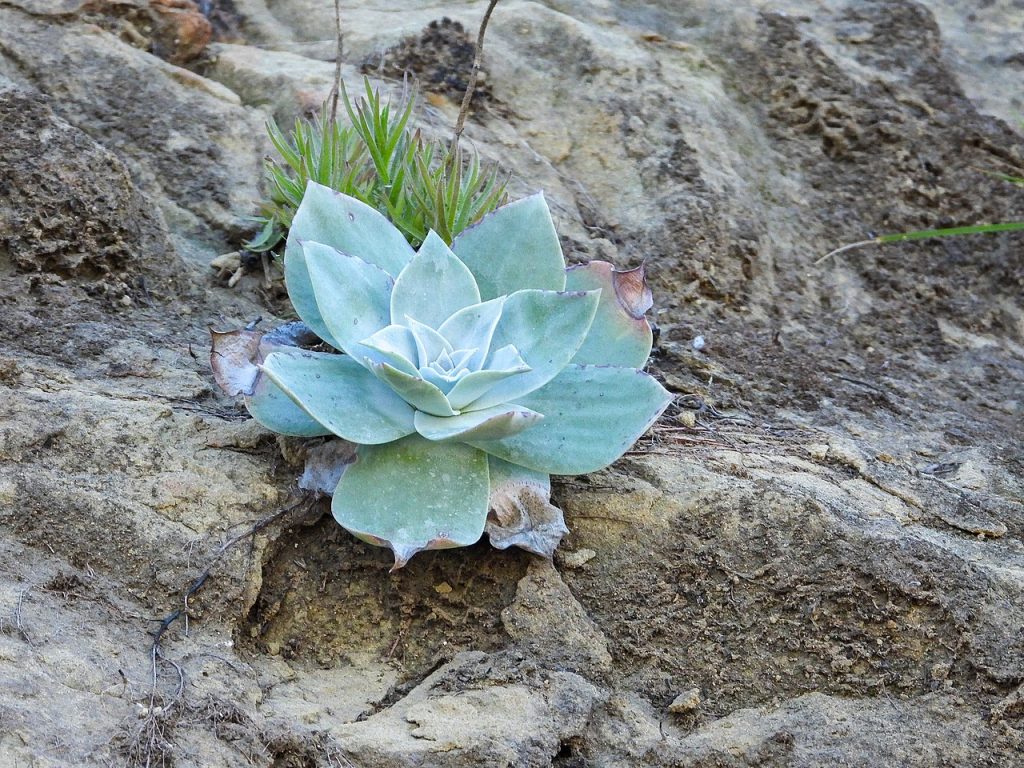
This succulent perennial is native to southwestern US and northern Mexico where it is found in rocky areas in coastal and inland mountains and desert foothills. It is a member of the stonecrop family, Crassulaceae, that also includes sedum, jade plant, and hens and chicks. The plant grows 4-12″ tall and has a thick stem up to 2″ wide that forms a dense basal rosette of fleshy pale green leaves that age to a pinkish papery texture. The leaves are spoon-shaped with acute tips and up to 12/long, and the rosette can be 12-18″ across. In summer, the rosettes may fold inward to protect them from sunburn and drying out. Although usually solitary, the rosettes may form groups of 3-23. In late spring to early summer, 1-5 leafy, pinkish to silvery-white spikes, each 1-2′ long, arch upward, fork into 2-7 branches that bear clusters of numerous pinkish to red flowers attractive to hummingbirds and bumblebees. Chalk dudleya is drought tolerant, easy to grow, and a good choice for rock, wall, native plant, pollinator, hummingbird, and container gardens. When planting, place the plants on an angle to allow water to drain out of the rosette and avoid overhead watering. Other common names include chalk lettuce, and chalk liveforever, alluding to the white waxy powder all over the plant that brushes off like chalk. The genus name, Dudleya, honors William Russel Dudley (1849 – 1911), a botanist who taught at Cornell and Stanford. The specific epithet, pulverulenta, is from the Latin word pulvis meaing dust, plus the suffix -ulentus meaning full of, abounding in, and refers to powdery farina on the leaves.
Type: Evergreen succulent perennial
Bloom: Clusters of numerous pinkish to red flowers attractive on leafy, pinkish to silvery-white spikes, each 1-2′ long, in late spring to early summer
Size: 12-18′ H 12-18″ W
Light: Full sun, but partial sun on south facing slopes
Soil: Rocky, dry to medium moist, well-drained
Hardiness: Zones 8-10
Care: Can water occasionally in summer to maintain attractive appearance
Pests and Diseases: Aphids, mealy bugs
Propagation: Seed sown when ripe, leaf, root, stem cuttings in spring
Companion Plants: Agave, Lonicera hispidula (hairy honneysuckle), Symphoricarpos mollis (creeeping snowberry)
Outstanding Selections: None available
Photo Credit: James M. Maley Wikimedia Commons
 Karen Meyers