
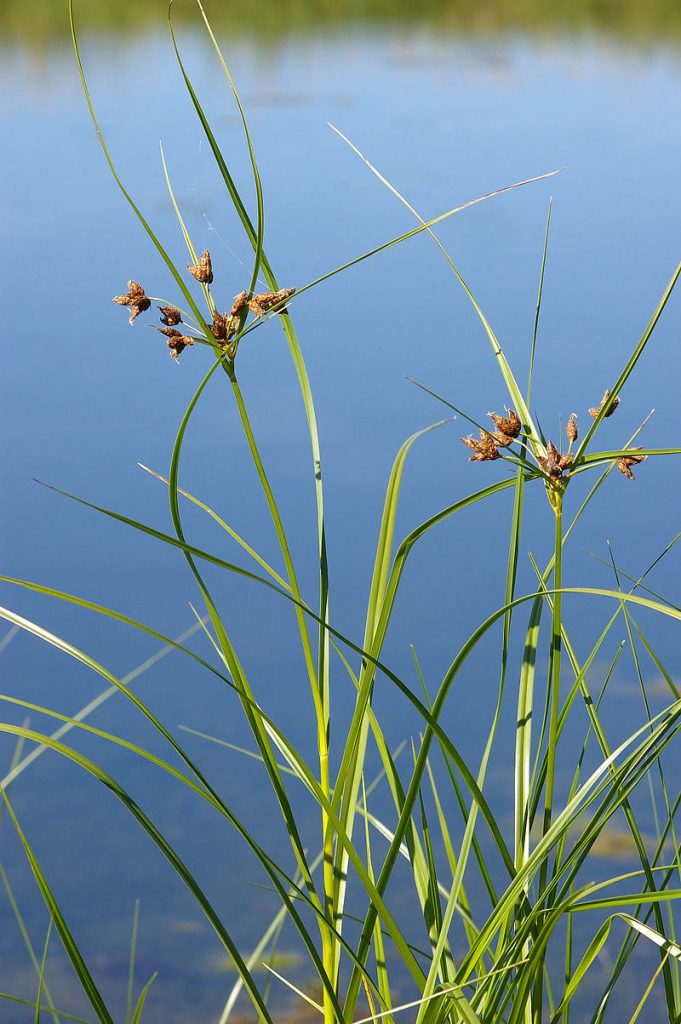
Also known as sea clubrush, cosmopolitan bulrush, alkali bulrush, and bayonet grass, this herbaceous perennial is native to salty, brackish or fresh marshlands habitats in much of the world and is especially common in New England and western parts of the US. It is a member of the sedge family, Cyperaceae, a grass-like family that also includes water chestnut, papyrus and the weed nutgrass/sedge. The plant usually grows about 3-4′ tall from a corm and produces rhizomes that form dense stands. It has triangular stems with sheathed by 3 to 6 leaves alternately arranged along the lower half of the stem. The leaves are flat, up to 16″ long, and have finely toothed margins. Terminal clusters of 3-25 golden brown, ovoid spikelets carry male and female flowers on the same plant in summer. The fruit is a tiny, tear-shaped achene. Salt marsh bulrush can grow in any kind of soil as long as it it wet, and can tolerate fresh or salt water and alkaline and saline soils. It is not usually used in gardens but would be suitable for bogs and ponds. Various parts of the plant are used by wildlife for food, cover or spawning. The genus name, Scirpus, comes from the ancient Greek word κάρφος (kárphos), meaning dry twig or straw. The specific epithet, maritimus, is the Latin word meaning of the sea and refers to the plants favored habitat.
Type: Herbaceous perennial
Bloom: Spikelets of golden brown male and female flowers on the same plant in summer
Size: 2-5′ H (usually about 3′)
Light: Full sun
Soil: Any soil as along as it is wet; tolerates fresh and salt water, alkaline and saline soil
Hardiness: Zones 5-9
Care: Low maintenance
Pests and Diseases: None of significance
Propagation: Seed, division in spring, root cuttings
Companion Plants: Cattail, rush, Iris pseudocorus
Outstanding Selections: None available
Photo Credit: Christian Fischer Wikimedia Commons