
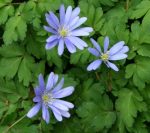
 Native to southern central Europe, this rhizomatous herbaceous perennial is a member of the buttercup family, Ranunculaceae, that also includes delphinium, clematis, and hellabore. It is a spring blooming plant that grows 6-8″ tall and has 1-1.5″ long leaves that are toothed and deeply lobed. The solitary semi-double flowers are 1.5′ across, lack petals but have 10-15 narrow sky-blue sepals, and are subtended by 3 stem leaves. Plants go dormant after blooming. A good choice for a rock garden, informal garden, and underplanting of shrubs. The genus name, Anemone, is probably a corrupted Greek loan word of Semitic origin referring to the lament for the slain Adonis or Naaman, whose scattered blood produced the blood-red Anemone coronaria. The specific epithet, apenniana, refers to the Apennines Mountains where the plant can be found.
Type: Herbaceous perennial
Bloom: Semi-double sky-blue flowers in spring
Size: 6-8″ H x 8″ W
Light: Sun to part shade
Soil: Average, humus-rich, consistently moist, well-drained
Hardiness: Zones 6-9
Care: Low maintenance
Pests and Diseases: Caterpillars, slugs, eelworms,
Propagation: Division when dormant; seed
Companion Plants: Anemonella thalicyroides, bleeding heart, hosta
Outstanding Selections:
‘Plena” ( fully double lavender-blue flowers)
‘Alba’ ( white flowers)
Photo Credit: Wikimedia