
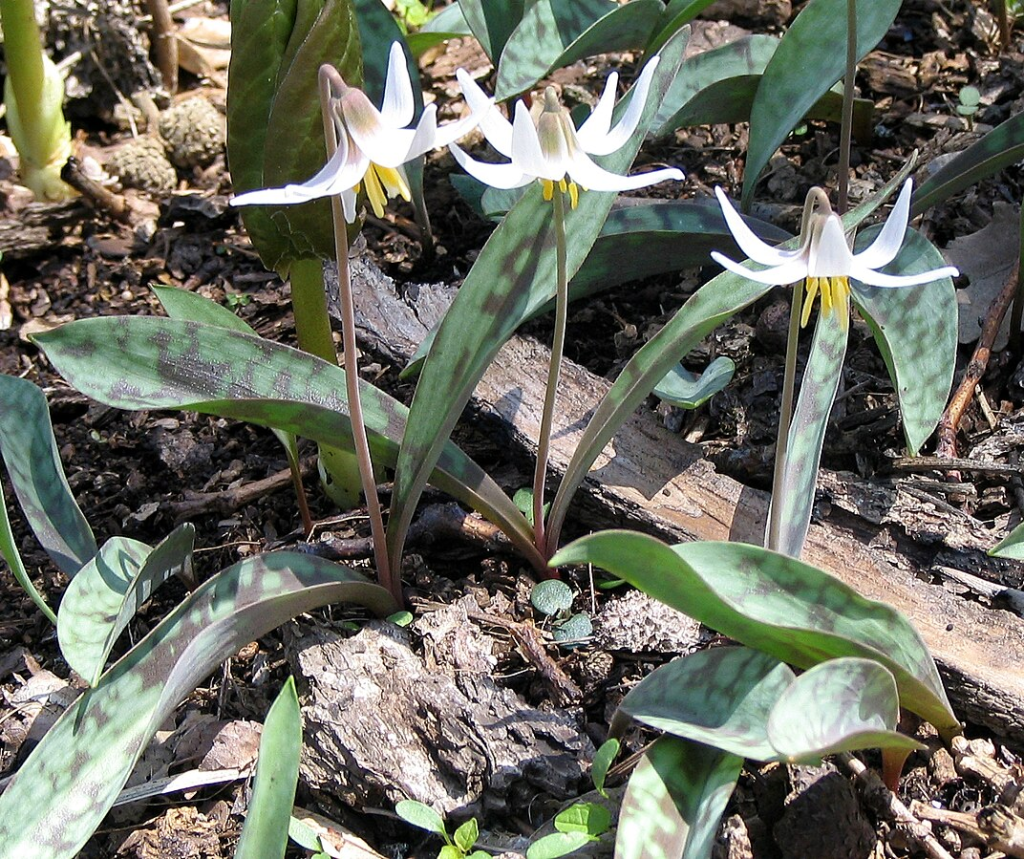
Also known as dog’s-tooth violet or adder’s tongue, the genus Erythronium includes 20-30 species and is in the lily family, Liliaceae, that also includes tulip, fritillary, and toad lily. They are perennials and all but six of the established species are native to North America where they grow in forests and meadows. Flowering plants have a pair of green leaves while vegetative plants have only one leaf. The leaves may or may not be mottled with brown, purple or white depending on the species. The bell-shaped flowers are usually nodding, may be single or in clusters of 2-5, and open only during the day. There are usually 6 tepals that may be ascending, spreading or recurved and white or yellow in color with tints or markings of pink to blue or purple . Anthers are conspicuous and may be white, yellow, pinkish, reddish, or brown. Some species are difficult to distinguish and the same common name may be used for more than one species. Plants usually like some shade and humus-rich, well-drained soil.
The genus name Erythronium comes from the ancient Greek ἐρυθρός (eruthrós) meaning red, and refers to the flower color of the type species, E. dens-canis.
Photo Credit: Wikipedia.
The environmental conditions of the Southeast have resulted in at least four native species of trout lily there although they may be native to other places too. The trout lilies described here are native to at least one state in the Southeast.
Small White Fawn Flower (Erythronium albidum)
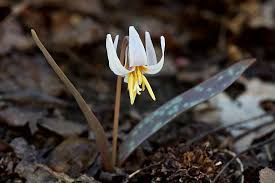
Paired basal leaves are 3-9″ long, elliptical, and may be mottled with silver-green or brown markings. The nodding flowers are carried singly on a 6-12″ long leafless stalk and are white, 1-2″ long and have recurved tepals. Six stamens have long yellow anthers.
Alternate Name/s: White trout lily, white dogtooth-violet, white fawnlily, adder’s-tongue
Native Range: Louisiana, Mississippi, Alabama, Arkansas, Tennessee, Kentucky, Virginia, and West Virginia as well as places in the Southwest, Midwest, Mid-Atlantic and New England.
Habitat: Moist to mesic woodlands
Type: Perennial, corm
Height: 6-12″
Bloom Time: Spring
Bloom Color: White with yellow
Light: Part shade to shade
Soil: Humusy, consistently moist, well-drained, acidic
USDA Hardiness Zones: 3-8
Photo Credit: Wikipedia
Trout Lily (Erythronium americum)
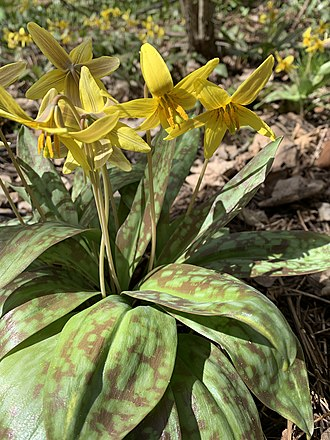
Paired basal leaves are elliptical, 4-6″ long, and pale green mottled with purplish-brown. The nodding, bell-shaped flowers are borne singly on leafless stalks up to 6″ tall and have yellow recurved tepals that are often tinged with purple on the back. Six long stamens have conspicuous deep rusty red or yellow anthers.
Alternate Name/s: Yellow trout lily, fawn lily, yellow adder’s-tongue, or yellow dogtooth violet
Native Range: Virginia, West Virginia, Kentucky, Tennessee, North Carolina, South Carolina, Georgia, Alabama, Mississippi, and Arkansas as well as places in the Midwest, Mid-Atlantic, and New England
Habitat: Moist deciduous woodlands; along streams
Type: Perennial, corm
Height: 3-6″
Bloom Time: Spring
Bloom Color: Yellow
Light: Part to full shade
Soil: Humusy, consistently moist, well-drained, acidic
USDA Hardiness Zones: 3-8
Photo Credit: Wikipedia
Yellow Trout Lily (Erythronium rostratum)
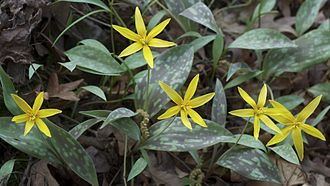
Paired basal leaves are 2-8″ long and green usually mottled with brown. A leafless stems carries a single flower with ascending or spreading yellow tepals tinged red-purple or orange. Unlike other trout lilies, the flowers are not nodding. Conspicuous anthers are yellow.
Alternate Name/s: Yellow fawnlily, beaked trout lily, golden-star
Native Range: Arkansas, Louisiana, Alabama, Tennessee, and Kentucky as well as places in the Southwest and Midwest
Habitat: Mesic woods, bottomlands, flood plains and along waterways, shaded lower ledges of bluffs
Type: Perennial
Height: 4-8″
Bloom Time: Early spring to late spring
Bloom Color: Yellow
Light: Part shade
Soil: Humusy, consistently moist, well-drained, slightly acidic
USDA Hardiness Zones: 4-8
Photo Credit: Eric Hunt, Wikimedia Commons
Dimpled Trout Lily (Erythronium umbilicatum)
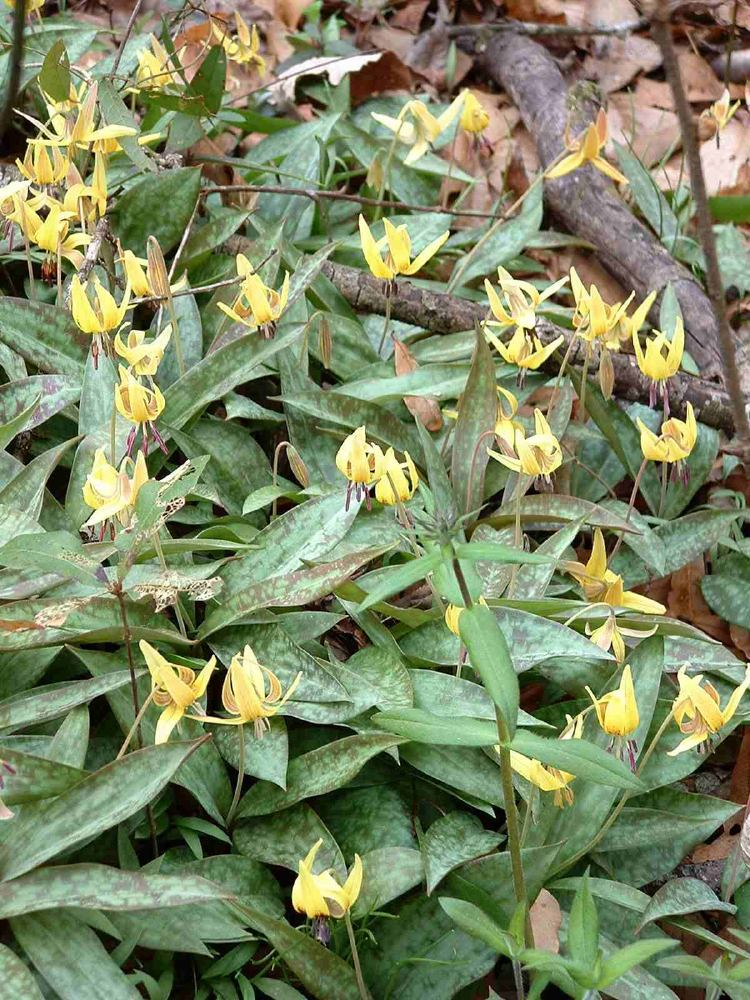
A pair of basal leaves are 3-5″ long, oval, and mottled with irregular markings of green, brown and purple. A leafless stem carries a single, nodding flower with recurved yellow tepals often brushed with purple on the outside. Conspicuous anthers are brownish-purple.
Alternate Name/s: Dimpled dog toothe violet, dimpled fawn lily
Native Range: Virginia, West Virginia, Kentucky, Tennessee, North Carolina, South Carolina, Georgia, Alabama and Florida as well as places in the Mid-Atlantic
Habitat: Bottomland or slope forests, as well as in rather dry upland habitats
Type: Perennial
Height: 4-10″
Bloom Time: Early winter to mid spring
Bloom Color: Yellow
Light: Partial shade to shade
Soil: Humusy, consistently moist, well-drained, acidic
USDA Hardiness Zones: 4-9
Photo Credit: Tim Ross, Wikimedia Common
The Southeast includes Virginia, West Virginia, North Carolina, South Carolina, Georgia, Alabama, Mississippi, Louisiana, Arkansas, Kentucky, Tennessee, and Florida. Most of these states are characterized by hot, humid summers and cool to mild winters, with Florida’s tip being tropical. Summers are generally hot and humid throughout the entire region. Precipitation is abundant in the area and comes mostly in the form of rain.