
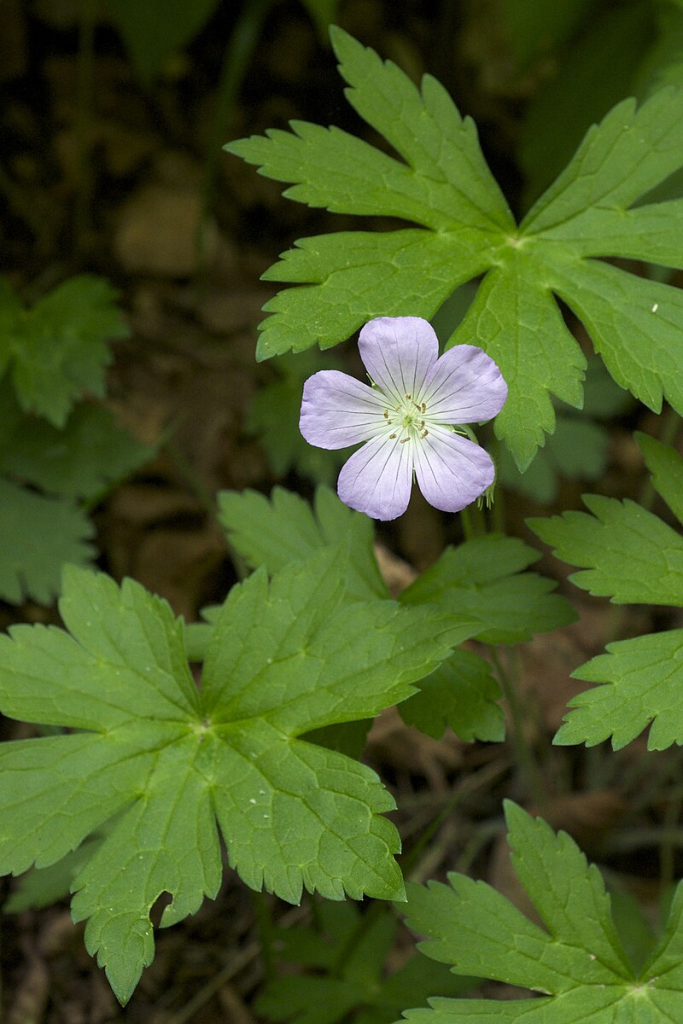
Early European settlers learned about the medicinal use of G. maculata from the indigenous people of North America where the plant was native and they incorporated it into their own herbal remedies. The use of a plant in herbal medicine is associated with Mary as a symbol of compassion, nurturing and healing. The distinctive pin-like seed pods of G. maculata further linked the the plant to Mary by recalling her humility in regard to domestic chores such as sewing, an activity she is assumed to have performed in her role of wife and mother.
Photo Credit: Wikimedia Commons
This clump-forming herbaceous perennial is native to woodlands of eastern US from Maine to Georgia and west to the Dakotas and Oklahoma. It is a member of the Geraniaceae plant family that includes Pelargonium, the garden plant called geranium. Deeply cut basal leaves arise from a thick, branched rhizome and form a mound of foliage up to 24″ tall and 18″ wide. Each leaf is up to 6″ across and palmately lobed with 5 lobes. In spring, leafy stems produce pink to lilac flowers over 6-7 weeks. Each 5-petaled flower is 1-1.6″ across, saucer-shaped, and upward facing. The seed capsules that follow are beaked and are thought to resemble a crane’s bill. The flowers attract butterflies and other pollinators and the seeds are eaten by birds and small mammals. Other names for wild geranium are alum root, alum bloom, spotted cranesbill, wild cranesbill, spotted geranium, and wood geranium.
The genus name, Geranium, comes from the Greek word γέρανος (géranos) meaning crane and refers to the appearance of the seed capsule. The specific epithet, maculatum, is the Latin word meaning spotted or stained and refers to markings that may appear on the plant.
Cranesbill likes light shade to full sun and average, medium moist, well-drained soil in USDA Hardiness Zones 3-8. It tolerates poor soil and is generally healthy but may suffer damage from rust, leafspot, snails and slugs. Propagation is by division and seed.
 Karen
Karen