
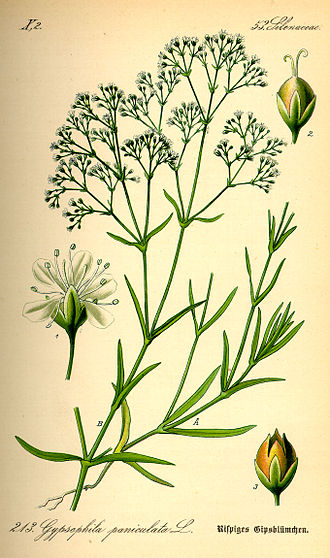
Baby’s breath is a relatively new introduction in Mary gardens. It was first introduced to European gardens in the early 19th century as an ornamental plant and was absorbed into Christian symbolism after that time. The delicate white flowers are associated with Mary’s innocence and purity and the cloud like clusters of small flowers resemble the veil usually worn by her. In the Christian tradition, Mary’s veil symbolizes her purity, humility, devotion. protection, and divine grace.
Photo Credit: Wikimedia Commons
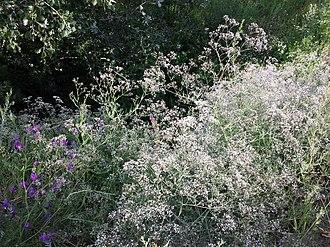
Baby’s breath is a herbaceous perennial and a member of the carnation family, Caryophyllaceae, that also includes pinks and campions. It is native to central and eastern Europe but is naturalized in North America and is now considered invasive from new Brunswick to British Columbia, south to Pennsylvania, Oklahoma, and California. Plants grow 2-4′ tall and have highly branched stems with narrow, gray-green leaves up to 4″ long. Panicles of 1/16″ wide white flowers appear in mid-summer. Gypsophila is a long day plant and flowers more quickly when the daylength is more than 14 hours.
The genus name Gypsophilia comes from the Greek words gypsos meaning chalk and philia meaning friendship which refers to the plants’ fondness for soils with a high pH. The addition of lime to acidic soil is probably necessary for all the members of the genus to thrive. The specific epithet, paniculata, comes from the Greek word penos meaning web and refers to the arrangement of the flowers.
Baby’s breath likes full sun and average, medium dry, well-drained , basic (7.0-7.5) soil in USDA Hardiness Zones 3-9. Plants are generally healthy but may suffer damage from botrytis or aster yellows. Propagation is by seed, division, and terminal cuttings after flowering.
Photo Credit: Wikipedia