
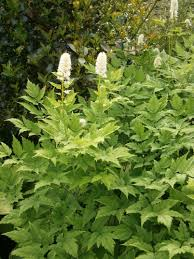
Actea is a genus of herbaceous perennials in the buttercup family, Ranunculaceae, that also includes anemone, monkshood, and delphinium. They are native to subtropical, temperate and subarctic regions of Europe, Asia and North America where they are often found in forests, woodland openings, and deciuous woods. Growing from a thick rhizome, plants have one or more branching stems, large, pinnately divided leaves with toothed leaflets, and clusters of small fluffy white flowers that may attract pollinators. The fruit is a white, red, or purplish-black berry with a black dot which has led to the common name, “doll’s eyes”. The whole plant is poisonous, the berry is especially so, but birds are not affected by the poison and may eat the berries. Acteaes like part shade and humusy, consistently moist, well-drained soil. They have no significant pests or diseases and are propagated by division or seed.
The genus name, Actea, is derived from the Greek name for elder, Ἀκταία, (Actaia) because the leaves are similar in appearance.
Photo Credit: Wikipedia
The environmental conditions in the Mid-Atlantic have resulted in at least four species of Actea native to the Mid-Atlantic although they may be native to other areas in the US too. The Actea described here are native to at least one of the states in the Mid-Atlantic.
White Baneberry (Acteae pachypoda)
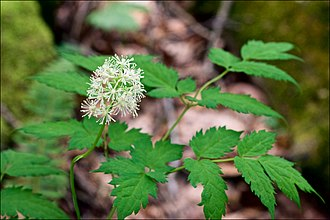
Each stem has 2 or 3 bipinnate compound leaves that are toothed, up to 16″ long, and valued ornamentally for their attractive appearance. Dense terminal racemes of 10-28 tiny white flowers grow above the foliage, are up to 3.9″ long, and attract bees. The flowers give way to white berries 1/2″ in diameter and marked with a black spot. The pedicels thickens, become bright red and add interest into fall. The berries are very toxic to humans and many animals but they are eaten by birds without harm and the seeds are eaten by small mammals. Photo Credit: Wikipedia
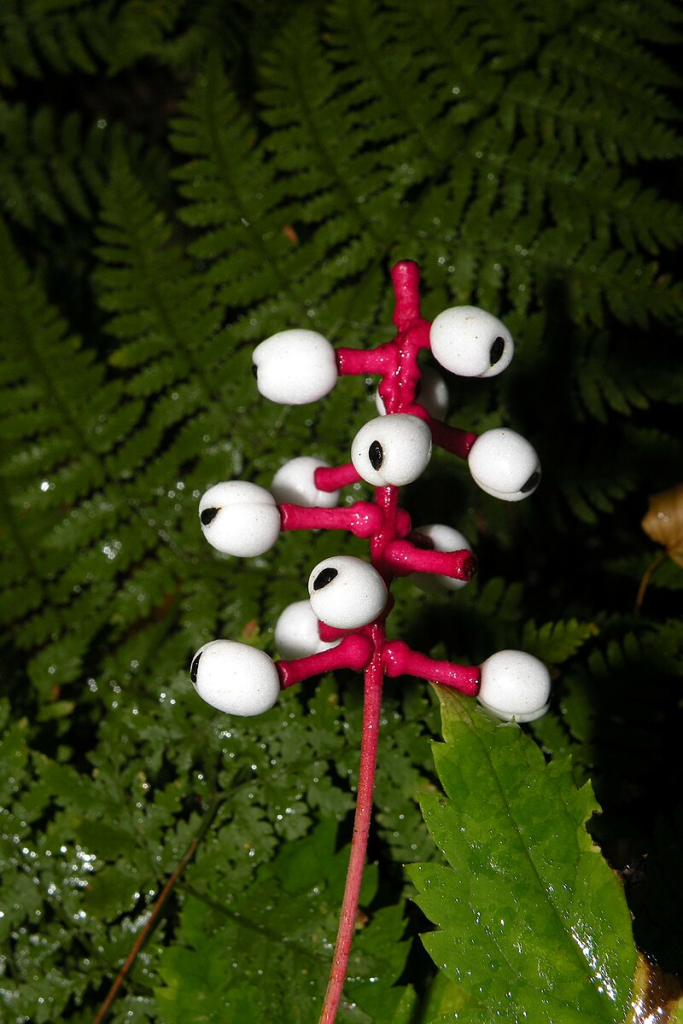
Alternate Name/s: White cohosh, doll’s eyes, necklace weed, toadroot, white beads.
Native Range: Delaware, Maryland, New Jersey, New York, Pennsylvania, and the District of Columbia as well as places in the Southeast, New England, Midwest and Southwest.
Habitat: Deciduous woodlands, thickets
Type: Perennial
Height: 1-3′
Bloom Time: Spring to early summer
Bloom Color: White
Light: Dappled to deep shade
Soil: Humusy, consistently moist, well-drained
USDA Hardiness Zones: 3-8
Photo Credit: Doug McGrady, Wikimedia Commons
Mountain bugbane (Acteae podocarpa aka Cimicifuga americana)
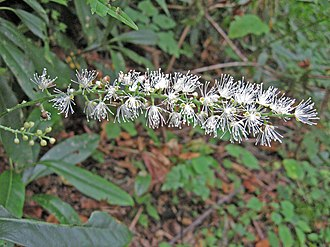
The fern-like foliage on branched stems forms a clump 3-4″ tall and consists of deeply-cut leaves with oval to oblong, 3-lobed, toothed leaflets up to 4″ long. Branched terminal racemes up to 20″ long carry tiny white apetalous flowers 5-6″ above the foliage. Each flower is 2/3″ across and has a foul scent that attracts flies for pollination.
Alternate Name/s: Mountain black-cohosh
Native Range: Pennsylvania and Maryland as well as places in the Southeast and Midwest
Habitat: Moist woods
Type: Perennial
Height: 3-8′
Bloom Time: Late summer into fall
Bloom Color: White
Light: Part shade to full shade
Soil: Humusy, consistently moist, well-drained
USDA Hardiness Zones: 3-9
Photo Credit: Wikipedia
Black Cohosh (Acteae racemosa aka Cimicifuga racemosa)
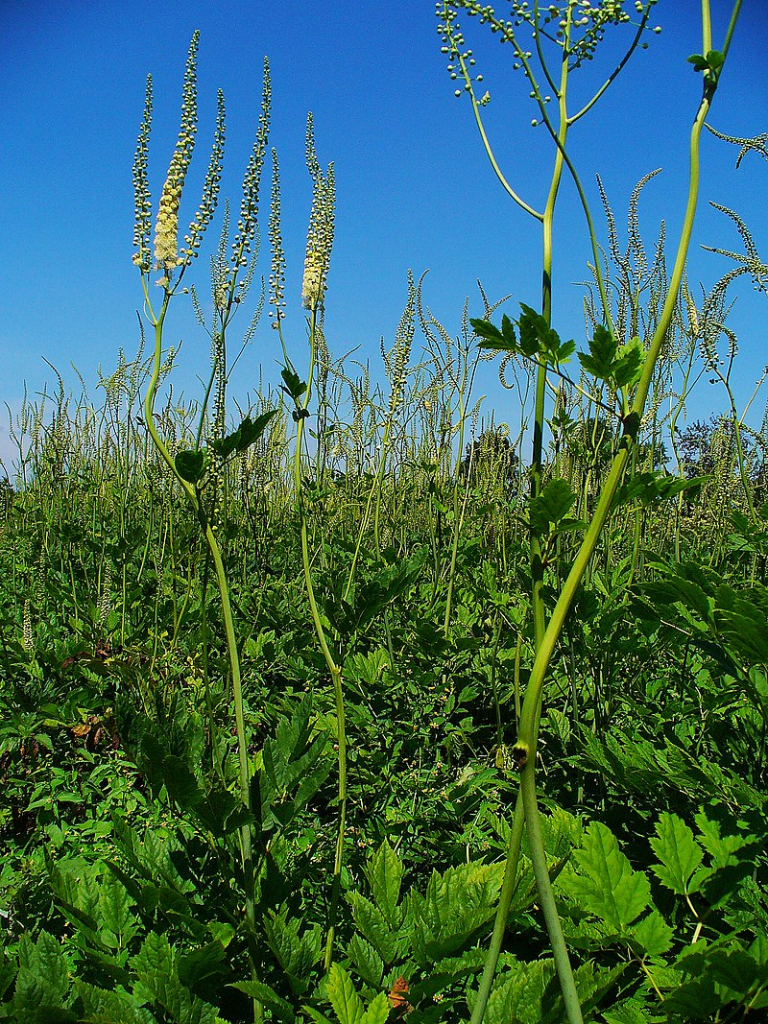
The compound basal leaves are up to 3′ long and are divided into compound leaflets that are lobed and have toothed margins. Wiry stems carry small creamy white flowers in 1-2′ long terminal racemes well above the foliage. The flowers lack petals and sepals, and consist of numerous stamens surrounding a single stigma. The scent of the flowers attracts flies, gnats, and beetles
Alternate Name/s: Black bugbane, black snakeroot, rattle-top, fairy candle
Native Range: New York, Pennsylvania, New Jersey, Delaware, Maryland and District of Columbia as well as places in the Southeast, New England and Midwest
Habitat: Woodlands and woodlands openings
Type: Perennial
Height: 4-6′
Bloom Time: Summer
Bloom Color: White
Light: Part to full shade (flowering best with at least 3 hours of morning sun)
Soil: Humusy, consistently moist, well-drained
USDA Hardiness Zones: 3-8
Photo Credit: H. Zell, Wikimedia Commons
Red Baneberry (Acteae rubra)
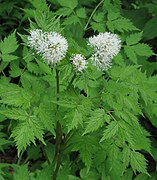
Leaves form bushy clumps of foliage and are twice divided with 3 or 5 leaflets in each group. Leaflets are up to 2″ long, hairy, and are coarsely toothed and sometimes lobed. The flowers appear in rounded clusters about 2″ across on the ends of long stems above the foliage. Each flower is about 1/4″ wide and has 4-10 white, petal-like sepals surrounding a cluster of white tipped stamens that are longer than the sepals. The fruit is an attractive green berry that ripens to red and is poisonous.
Alternate Name/s: Coral berry, rattlesnake herb, snakeberry
Native Range: Pennsylvania, New York, and New Jersey as well as places on the Pacific Coast, and in the Rocky Mountain area, Southwest, Midwest and New England
Habitat: Moist, woods and thickets, along stream banks and in swamps
Type: Perennial
Height: 1-3′
Bloom Time: Late spring to early summer
Bloom Color: White
Light: Part shade
Soil: Humusy, consistently moist, well-drained
USDA Hardiness Zones: 3-7
Photo Credit: Robert Flogaus-Faust, Wikimedia Commons
The Mid-Atlantic region includes Delaware, Maryland, New Jersey, New York, Pennsylvania, and the District of Columbia. The region is characterized by cold winters and hot summers, high humidity in summer along some areas along the coast, and precipitation between 32 and 52″ per year.