
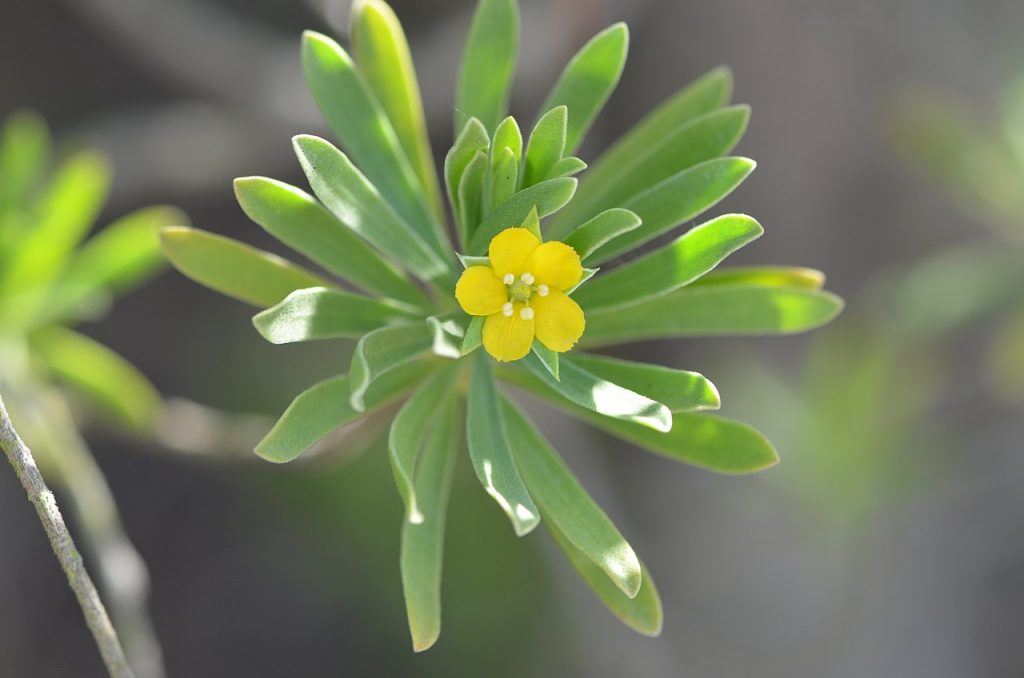
Native to tropical coasts in most regions of the world including southern Florida, this evergreen shrub is a member of a small plant family, Surianaceae, that consists of only 8 species. It can grow up to 20′ tall and has a branched trunk with dark brown, flaky, rough bark and arching branches that carry gray-green, succulent leaves that are downy, up to 2.4″ long, and have a cedar-like aroma when crushed. Throughout the year, small cup-shaped yellow flowers appear singly or in short clusters and give way to small hard dry fruits that are buoyant and facilitate seed dispersal by the sea. The flowers are attractive to butterflies and bees, and the plant serves as a host for 2 hairstreaks. Bay cedar is valued for beach and dune erosion control and can be grown in a container or trimmed as a hedge or screen. The genus name, Suriana, honors Joseph D. Surian, an 18th century French botanist. The specific epithet, maritima, is the Latin word, meaning seacoast and refers to the favored habitat of the plant.
Type: Evergreen shrub
Outstanding Features: Flowers, foliage
Form: Oval
Growth Rate: Slow
Bloom: Half inch wide, cup-shaped yellow flowers throughout the year
Size: 6-20′ H x 6-10′ W
Light: Full sun
Soil: Sandy, dry, well-drained; highly tolerant to drought, heat, wind, and salt spray; tolerant of moderately saline soil and brief inundations
Hardiness: Zones 10-11
Care: Responds well to trimming
Pests and Diseases: None of significance
Propagation: Seed
Outstanding Selections:
Photo Credit: Bobyellow Wikimedia Commons
 Karen Meyers