
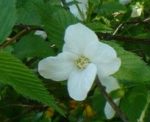
 Jetbead is a mounding deciduous shrub growing 3-6’ tall and is native to Japan and central China. It was introduced into the US in 1866 as an ornamental and has become invasive from New England to Wisconsin, south to South Carolina and Alabama, where it creates a dense shrub layer in forested areas, displacing native vegetation. The medium green leaves are bright green , have prominent veins, and densely cover the plant but have unremarkable fall color. The 2” wide 4-petaled white flowers appear in late spring and give way to glossy black fruits that persist into winter. The shrub has limited ornamental value but is easy to grow, tolerates full sun to full shade and a wide range of soil conditions, and can be sheared or heavily pruned. USDA Hardiness Zones 4-8
Oakleaf Hydrangea (Hydrangea quercifolia)
Native to wooded slopes and shaded rocky outcroppings from Georgia to Florida and Mississippi, oakleaf hydrangea is a deciduous shrub with large conical panicles of white sepals and fertile flowers beginning in June. The leaves are u to eight inches long and often turn red to burgundy in the fall. USDA Hardiness Zones 5-9
Alabama Snow-Wreath (Neviusia alabamensis)
With puffy clusters of white flowers and pleated leaves this rounded, deciduous suckering shrub grows 4-6’ tall and 6-8’ wide and is native to open woods and rocky cliffs in Mississipppi, Alabama, Georgia, Tennessee, and Arkansas. USDA Hardiness Zones 4-8
Virginia Sweetspire (Itea virginica)
An arching to rounded deciduous to semi-deciduous shrub, Virginia sweetspire grows up to 4-8’ tall and wide and has fragrant white bottlebrush flowers and long green leaves up to 4” long that turn various shades of crimson, burgundy, and purple in full sun or orange, gold and scarlet in part to full shade. It is native to streams and pond margins, swamps, and low woods from New Jersey and Missouri, south to Florida and Louisiana. USDA Hardiness Zones 5-9
Sweet Shrub (Calycanthus floridus)
Also called Carolina allspice, this rounded suckering deciduous shrub has 6” long lustrous dark green leaves turning yellow in fall, and very fragrant, brown to reddish 2” wide flowers in spring. It is native to woodland edges from Pennsylvania to Florida and Mississippi. USDA Hardiness Zones 4-9
Spicebush (Lindera benzoin)
Growing up to 15’ tall, this deciduous shrub is native to floodplains, bottomlands, streamsides, and cove forests from Maine and Ontario, south to Florida and Texas. It has aromatic light green leaves that are food for swallowtail butterfly larva and provide attractive yellow autumn color. Female flowers produce red berries that are attractive to birds and are revealed as the leaves fall. USDA Hardiness Zones 4-9
Red Chokeberry (Aronia arbutifolia)
This vase-shaped deciduous suckering shrub grows 6-10’ tall and has brilliant red fall foliage and glossy red fruit that persists into winter. It is native to both wet and dry thickets in eastern North America from Nova Scotia and Ontario to Ohio south to Texas and Florida. USDA Hardiness Zones 4-9
Black Chokeberry (Aronia melanocarpa)
Black chokeberry is a mounding to rounded deciduous shrub growing up to 6’ tall and native to swamp, woodland clearings, wetland forests, and outcroppings from Newfoundland to Ontario, south to Georgia and Arkansas. It has dark green foliage that turns crimson to burgundy-red in the fall and white flowers with pink anthers in mid spring that give way to glossy black fruit in late summer. USDA Hardiness Zones 3-9
Mock Orange (Philadelphus lewisii)
Growing up to 10’ tall, mock orange is a deciduous shrub with ovate green leaves and clusters of 1.6” wide, 4-petaled flowers in spring to summer with the fragrance of orange blossoms. Native to gullies, water courses, rocky cliffs, talus slopes, and rocky hillsides of sagebrush deserts from British Columbia to northern California, to Montana and central Idaho. USDA Hardiness Zones 4-8
Ninebark (Physocarpus opulifolius)
Ninebark is a rounded to mounding deciduous shrub growing 4-8’ tall with exfoliating bark and domed clusters of creamy-white flowers in late spring and early summer followed by berries that persist into winter. It is native to open woods, lakeshores, streambanks, rock outcroppings, and prairies from New Brunswick to Ontario, south to Georgia and Arkansas. USDA Hardiness Zones 3-8
Maple-Leaf Viburnum (Viburnum acerifolium)
This deciduous suckering shrub grows 3-6’ tall and produced tiny white flowers flat-topped cluster 3’ across in late springfollowed by bluish-black berries in late summer. The maple- like leaves are 2-5 inches long and turn reddish-purple to magenta in fall. Plants attract butterflies and birds and are native to woodlands from Maine, Ontario and Wisconsin, south to Georgia and Louisiana. USDA Hardiness Zones 3-8
Fragrant Sumac (Rhus aromatica)
Fragrant sumac is a deciduous shrubs producing dense clusters of red seed pods and red foliage in the fall. It grows up to 6’ tall and is native to forest edges rock outcroppings, shale barrens, and dry uplands from Vermont to Minnesota, south to Florida and Louisiana; USDA Hardiness Zones 4-8.
Arrowwood (Viburnum dentatum)
Growing 6-10’ tall, arrowwood is a deciduous shrub with 4” wide flat topped clusters of white flowers in late spring. Blue-black berry-like fruit are attractive to birds. Leaves turn yellow, orange and red in autumn but coloration is variable depending on the specific plant. Arrowwood is native to grasslands, woodlands, and shores of rivers, lakes and swamps from Massachusetts south to Florida and west to Texas. USDA Hardiness Zones 2-8