
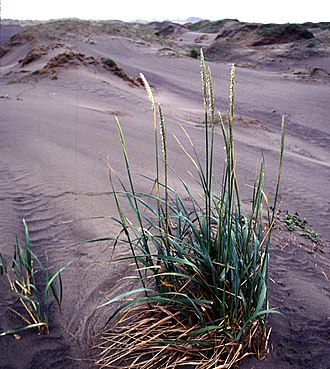
Also known as Pacific lyme grass, American dune wild-rye, sea lyme-grass, strand-wheat, and strand grass, this perennial grass is native to coastal beaches of northern Asia, and northern parts of both coasts of North America, most conspicuously from Southern California to Alaska. It is a member of the grass family, Poaceae, that also includes corn, rice, and bamboo. Plants has a rhizomatous root system and blue-green leaves that are 1/2-1″ wide and 2-3′ long but tend to bend over and produce an effective height of 1-2′. In summer, bluish-green flower spikes emerge and mature to wheat color by late summer but are not considered showy. Each spike is unbranched, to up to 13″ long, and consists of 4-6 spiklets. Pacific dune grass is one of the first plants to become established in sand dune formation and is valuable for slope stabilization and erosion control. It is an excellent plant for coastal garden as it tolerates salt spray, saline soil, unstable substrate, low nutrient levels, and wind. Plants may go dormant in the summer where water is lacking. The genus name, Elymus, is from the ancient Greek word ἔλυμος (élumos) referring to millet. The specific epithet, mollis, is the Latin word meaning soft and refers to the foliage.
Type: Perennial grass
Bloom: Spikes of bluish-green flowers in summer fading to wheat color by late summer
Size: 2-3′ H
Light: Full sun
Soil: Sandy, medium moist to dry, well-drained; goes dormant in summer if water lacking
Hardiness: Zones 7-10
Care: To refresh foliage, cut back in mid summer to 4″, fertilize and water.
Pests and Diseases: None of signficance
Propagation: Seed, division in late fall to early spring
Companion Plants: Lathyrus japonicus ( sea pea, beach pea), Achillea millefolium (common yarrow), Rosa rugosa
Outstanding Selections:
‘Reeve’
‘Benson’
Photo Credit: Wikispecies