
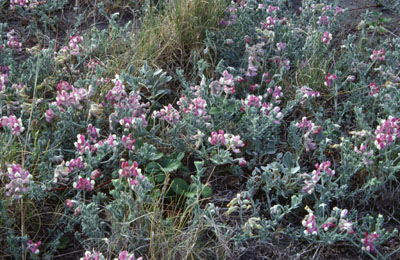
Also known as silky beach vetching, strand sweet pea, and dune sweet pea this rhizomatous herbaceous perennial is native to beaches and dunes along the coastline of western North America from British Columbia to California. It is a member of the legume family, Fabaceae, that also includes beans, lupines, and black locust. The plant grows into a mound 1.6-2′ tall and has weak, hairy, gray-green, branched stems carrying woolly leaves. The leaves are pinnately divided into 4-8 oval or oblong, scoop-shaped, overlapping leaflets. In spring, dense racemes of 4-8 flowers appear. Each pea-like flower is .4-8″ wide, purple to red-purple and has delicate dark pink to white veining. The flowers are fertilized by honeybees and bumblebees and give way to hairy, oval pods that are about 1″ long and contain 1-5 seeds. Silky beach pea is valued for dune restoration and use in seaside, wildlife, pollinator, and native plant gardens. The genus name, Lathyrus, is from the ancient Greek λάθυρος (láthuros) meaning composed of , (the prefix la- meaning very , and the suffix –thyros meaning passionate.) The specific epithet, littoralis, is the Latin word meaning of or belonging to the seashore.
Type: Herbaceous perennial
Bloom: Dense racemes of 4-8 purple to red-purple flowers in spring
Size: 1.6-2′ H
Light: Full sun
Soil: Sandy to average, dry to medium moist, well-drained
Hardiness: Zones 8-11
Care: Low maintenance
Pests and Diseases: None of significance
Propagation: Scarified and/or stratified seed
Companion Plants: Sand verbenas, beach morning glories, American dune grass
Photo Credit: Susan E. Nyoka Wikimedia Commons