
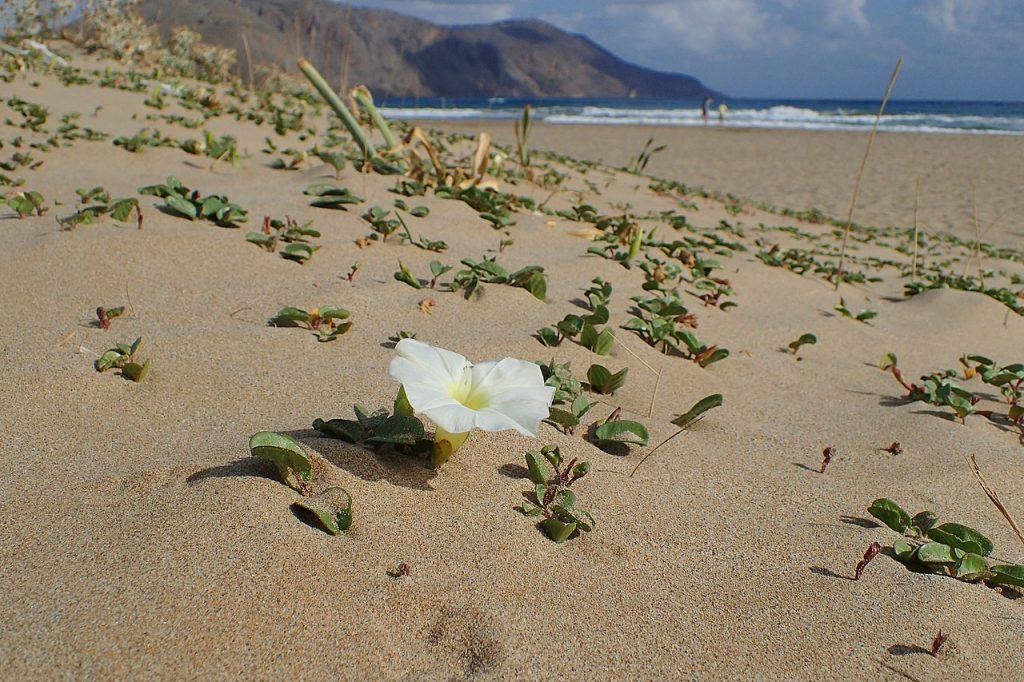
This creeping perennial vine is native to coastlines of tropical and subtropical areas around the world where it grows on sandy beaches and dunes. It is a member of the bindweed family, Convolvulaceae, that also includes sweet potato, Hawaiian baby wood rose, and dodder. The vine is low growing but quickly spreads by stolons to form mats 10-50′ across. The smooth fleshy stems carry elliptic to oval, leathery, succulent leaves that are lobed with an apical notch. Solitary, axillary flowers appear from summer to fall, sometimes year round. They are funnel-shaped, about 2+” across, and have fused white petals with yellow centers. As the common name implies, the flowers open in the morning and wilt and close up in the afternoon. The fruit is a capsule containing 4 large seeds. The flowers attract hummingbirds and the seeds provide food for wildlife. Beach morning glory is tolerant of drought, salt spray, and lean soil so is valued for stabilizing dunes. The genus name, Ipomoea, comes from ancient Greek words ἴψ (íps) meaning wormwood, and ὅμοιος (hómoios) meaning resembling. The specific epithet, imperati, is the Latin word meaning regal.
Type: Evergreen, herbaceous perennial vine
Bloom: White flowers with 5 fused petals from spring to fall
Size: 6″ H x up to 30′ W
Light: Full sun
Soil: Sandy, dry to moist, well-drained
Hardiness: Zones 8-11
Care: Low maintenance
Pests and Diseases: None of significance
Propagation: Seed, cuttings, division
Companion Plants: Sea ox-eye, bay bean, beach verbena
Photo Credit Krzysztof Ziarnek, Kenraiz Wikipedia