
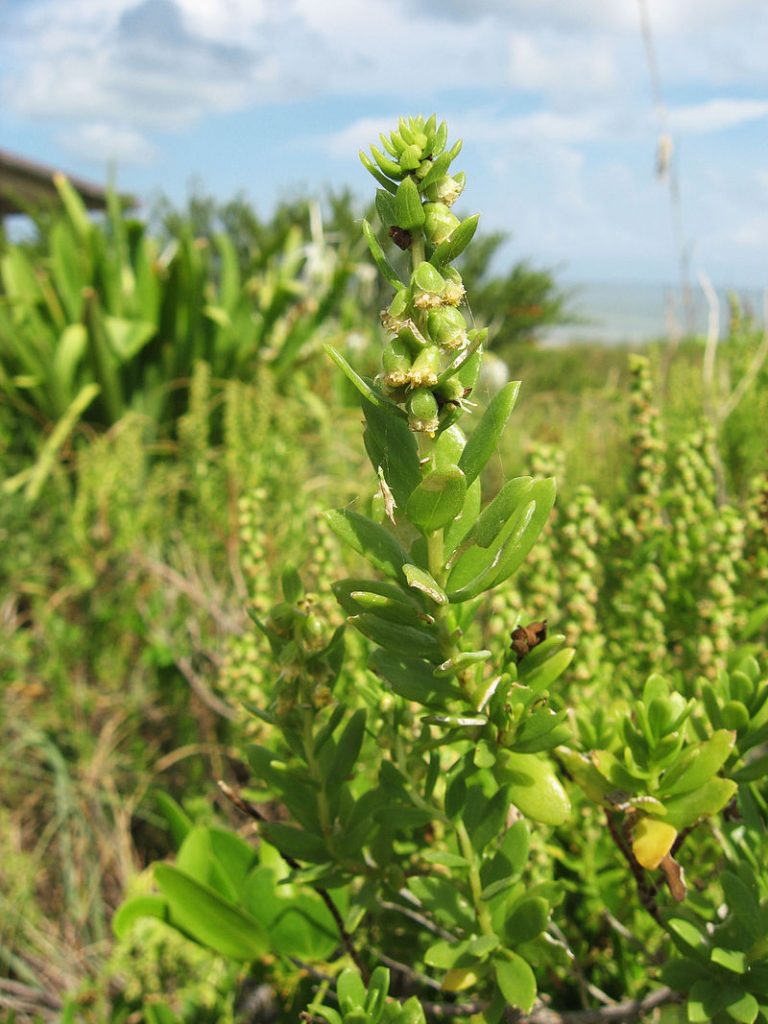
Also known as seashore elder, seacoast marshelder, and seacoast sumpweed, this evergreen shrub is native to coastal areas of the US from Virginia to Texas where it grows on sand dunes and upper beaches. It is a member of the aster family, Asteraceae, that also includes sunflower, yarrow and lettuce. The plant grows 2-3′ tall and has multiple spreading branches with vivid green succulent leaves that are lanceolate and .75-2″ long. In late summer, terminal racemes of inconspicuous flower heads appear that are composed of 2-17 creamy white to greenish disc flowers. The racemes elongate until fall. The fruits are inconspicuous yellowish-brown achenes arranged in globular clusters. Beach elder is tolerant of lean soil, drought, salt spray, and brief inundations of salt water. It spreads quickly as sand buries the stems and stimulates root formation in the stem tissue. Plants are valued for dune stabilization and can be used as a groundcover. The genus name, Iva, is of uncertain origin. The specific epithet, imbricata, is the Latin word meaning overlapping like shingles.
Type: Evergreen shrub
Outstanding Feature: Foliage
Form: Rounded
Growth Rate: Rapid
Bloom: Terminal racemes of inconspicuous flower heads of greenish to cream disc flowers
Size: 2-3′ H x 4-10′ W
Light: Full sun
Soil: Sandy, medium moist-dry, well-drained; tolerant of drought, salt spray, brief salt water inundations, and lean soil
Hardiness: Zones 8-11
Care: Low maintenance
Pests and Diseases: None of significance
Propagation: Cuttings, seed
Photo Credit: Mason Brock Wikipedia