
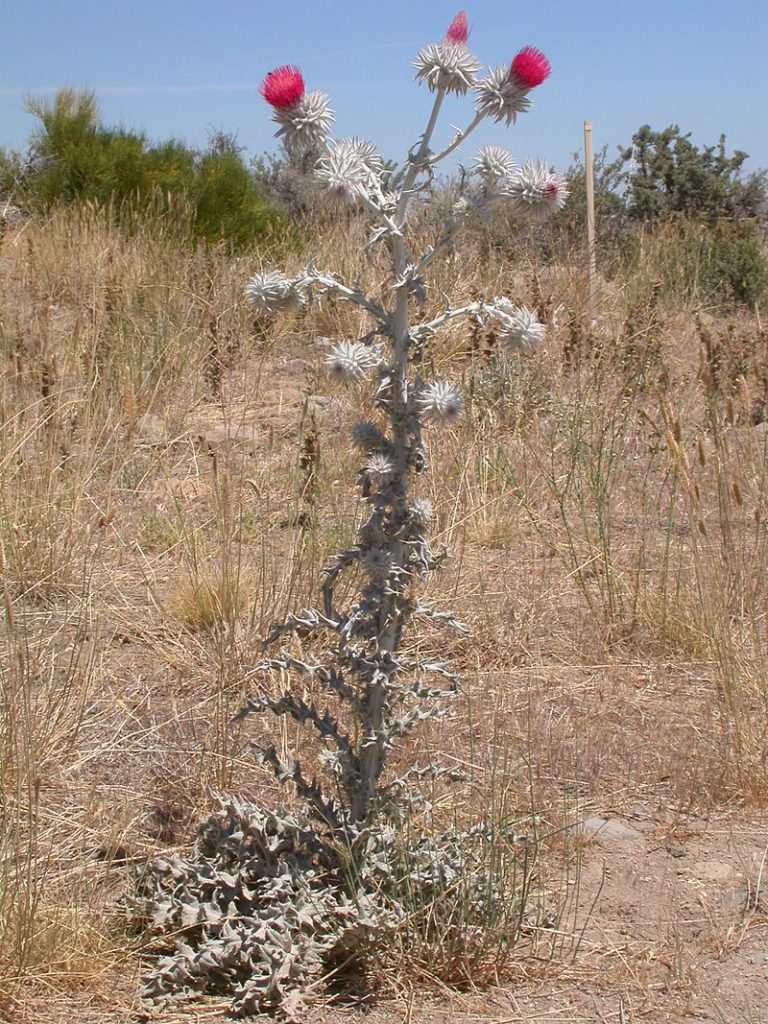
Also known as western thistle, snowy thistle, and red thistle, this biennial is native to California, western Nevada, southern Oregon, and southwestern Idaho where it grows on coastal strand, coastal sage scrub and chaparral. It is a member of the aster family Asteraceae, that also includes sunflower, goldenrod and lettuce. Growing 2-5′ tall from a taproot, the plant produces a basal rosette of leaves up to 1.6′ long the first year, and stout branched or unbranched flowering stems the second year. The stem leaves are ovate, pinnately lobed or divided, and have toothed or triangular lobed margins with sharp prickles. From spring into summer, mostly terminal, spherical flower head appear that are up to 3′ across and composed entirely of white, red or purple disc flowers. Each flower head is held within an involucre of large spiny phyllaries filled with silvery cobweb-like hairs. The fruit is a one seeded achene with a plumose tail. The flowers are attractive to butterflies and bees, the foliage serves as the larval host for several butterflies, and the seeds attract birds. The long silky hairs that cover all parts of the plant make this thistle especially notable and unlike most thistles, it is not a troublesome weed. Cobweb thistle is a good choice for native plant, coastal, wildlife, butterfly, and bird gardens. The genus name, Cirsium, is from the ancient Greek word κίρσισ ( kirsos) meaning swollen vein referring to the use of the thistle in antiquity in the treatment of swollen veins. The specific epithet, occidentale, is the Latin word meaning going down referring to the west where the sun goes down, and is a reference to the geographic location where the plant is native.
Type: Biennial
Bloom: Spherical flower head appear up to 3′ across of white, red or purple disc flowers within an involucre of large spiny phyllaries filled with silvery cobweb-like hairs.
Size: 2-5′ H
Light: Sun to part shade
Soil: Average, medium moist to dry, well-drained
Hardiness: Zones 7-10
Care: Low maintenance
Pests and Diseases: None of significance
Propagation: Seed
Companion Plants: Foothill penstemon (Penstemon heterophyllus), California poppy (Eschscholtzia californica), common tidy tips (Layia platyglossa).
Outstanding Selections: Several varieites exist differing most significantly in growth habit, flower color, and geographic area
Photo Credit: Matt Lavin Wikimedia Commons