
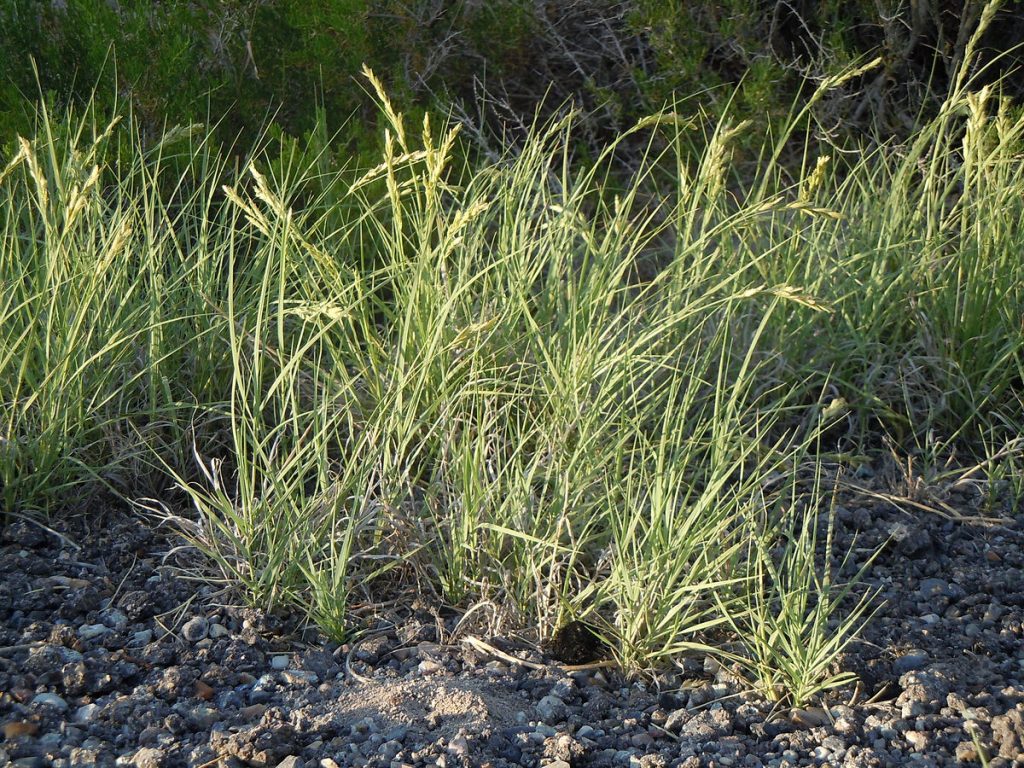
This perennial grass is known by many names including marsh spikegrass, alkali saltgrass, seashore saltgrass, desert saltgrass, inland saltgrass, and spikegrass. It is native and widespread in the Americas where it grows in a variety of habitats from coastlines, salt flats and dunes to forests, woodlands and desert scrub. A member of the grass family, Poaceae, it is related to rice, corn and bamboo. The plant grows 1-3′ tall and may for dense colonies with rhizomes and sometimes stolons. Stiff, flat leaves 2-6″ long are arranged in 2 rows on opposite sides of the unbranched stiff stem, often with the sheaths overlapping. The leaves may be crusted with salt in saline conditions due to the excretion of salt by glands in their tissues. In summer, raceme-like clusters of male and female flowers appear on different plants. Each cluster consists of 2-20 green or purple-tinted spikelets usually at the tip of the stem. Male spikelets are up to 1″ long with 5-20 flowers, while female spikelets are up to 1/2″ with 5-10 flowers. The spiklets turn straw-color as they mature and female spikelets produce smooth oval grains/seeds. Saltgrass is valued as food for livestock as well as for food and/or nesting grounds for wildlife such as birds, butterflies, small mammals. fish, and marine invertebrates. It is not commonly used for landscaping but may be used for bog or marsh gardens and is valuable for shoreline stabilization and restoration projects. The genus name, Distichlis, is from the Greek distichos, meaning two-ranked and probably refers to the arrangement of the flowers. The specific epithet, spicata, is the Latin word meaning spiked and refers to the inflorescence.
Type: Perennial grass
Bloom: Clusters of green or purple tinted male and female flowers on different plants in summer
Size: 1-3′ H
Light: Full sun
Soil: Sand, wet; tolerates salty and alkaline soils
Hardiness: Zones 7-10
Care: Low maintenance
Pests and Diseases: None of signficance
Propagation: Rhizome cuttings, seed
Companion Plants: Seaheath (Franklenia salina), goldenbush, , sea lavender, marsh fleabane, pickleweed
Outstanding Selections: ‘LK517f saltgrass’
Photo Credit: Matt Lavin Wikimedia Commons
 Karen Meyers