
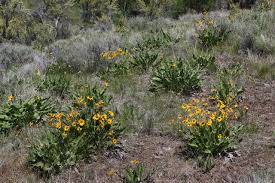
Balsamorhiza is a genus of perennials in the aster family, Asteraceae, that also includes daisies, dandelions and lettuce. Growing 8-36″ tall, plants typically have fleshy taproots, large basal leaves and erect stems that carry solitary flowerheads. Each flowerhead is made up of bright yellow ray florets surrounding a center of yellow disc florets. The entire plant is edible and nutritious but not considered tasty. Native Americans used the plants for medicine and food. Wildlife and livestock find the plants palatable. Native to western North America, balsamroot likes full sun and moderately moist to dry, well-drained soil.
The genus name, Balsamorhiza, comes from the Greek words βάλσαμον (bálsamon) meaning balsam, and ρίζα (rhiza) meaning root and refers to the fragrance of the root.
Photo Credit: Walter Siegmund, Wikimedia Commons
The environmental conditions in the Pacific Coast have resulted in at least six balsamroot species native there but may be native to other places too. All of the balsamroots described here are native to at least one of the states on the Pacific Coast.
Cary’s Balsamroot (Balsamorhiza careya)
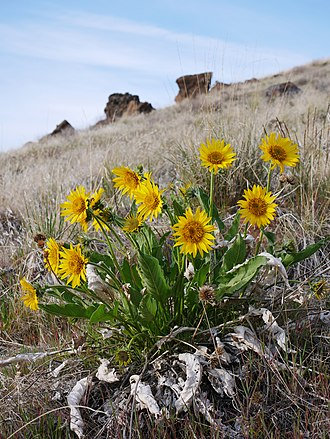
Plants form clumps of upward pointing shiny green leaves that are 6 to 20″ long and have a sand paper feel. Leafless stems carry 1 larger, terminal flower head and 1–6 smaller, axillary flower heads. Each large flower head consists of 8-20 ray florets, while smaller flower heads have 5-9. The ray flowers persist after bloom. Plants are slow growing and may take several years to bloom.
Alternate Name/s: None
Native Range: Washington and Oregon
Habitat: Arid and desert regions east of the Cascades
Type: Perennial
Height: 8-24″
Bloom Time: Late spring
Bloom Color: Golden yellow
Light: Full sun
Soil: Sandy, dry, to medium moist, well drained
USDA Hardiness Zones: 4-8
Photo Credit: Thayne Tuason, Wikipedia
Deltoid balsamroot (Balsamorhiza deltoidea)
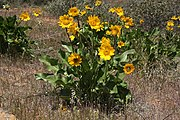
Hairy glandular leaves form clumps. are 8 -24″ long, and often have toothed margins. Flowering stalks up to 35″ tall bear 1-2 flower heads in spring. The flower heads are 3-5″ across and are made up of a center of yellow disc florets surrounded by 13-20 yellow ray florets. The flower heads attract pollinators and the seeds attract birds. The plant is long-lived but may take 5 years to bloom.
Alternate Name/s: Puget balsamroot
Native Range: Washington, Oregon, California
Habitat: Woodland openings and open hillsides
Type: Perennial
Height: 8-36″
Bloom Time:
Bloom Color: Yellow
Light: Full sun
Soil: Deep, dry to medium moist, well-drained
USDA Hardiness Zones: 4-8
Photo Credit: Walter Siegmund
Montane Balsamfoot (Balsamorhiza hookeri)
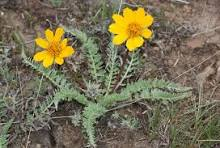
Highly divided arrow-shaped leaves are up to 16″ long, have silky hairs, and grow from a long taproot to produce a clump. In spring to mid summer, leafless flowering stems arise and produce terminal yellow flower heads 1-3″ across. Each flower head has 10-21 fringe-tipped ray florets surrounding a center of numerous disc florets. The flowerheads attract native bees.
Alternate Name/s: Hooker’s Balsamroot
Native Range: Washington and California, as well as parts of the Rocky Mountain area and Southwest
Habitat: Grassy, rocky, open woods at elevations of 2500-5000 ft.
Type: Perennial
Height: 12″
Bloom Time: Spring into early summer
Bloom Color: Yellow
Light: Full sun
Soil: Rocky, dry, well-drained
USDA Hardiness Zones: 4-8
Photo Credit: Walter Siegmund, Wikipedia
Hoary Balsamroot (Balsamorhiza incana)
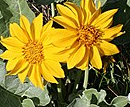
Basal leaves are lance-shaped to oblong, 4-17″ long, and pinnately divided with toothed leaflets. They are gray and have long woolly hairs. Yellow flower heads are carried on leafless stems except for a pair of small deeply divided leaves beneath each. The flower heads have13 or more ray florets surrounding a center of disc florets and attract native bees.
Alternate Name/s: None
Native Range: Washington and Oregon as well as places in the Rocky Mountain area
Habitat: Moderately moist to moderately dry open places such as meadows
Type: Perennial
Height: 8-36″
Bloom Time: Late spring to early summer
Bloom Color: yellow
Light: Full sun
Soil: Fertile, medium moist to dry, well-drained
USDA Hardiness Zones: 4-8
Photo Credit: Wikipedia
Cutleaf Balsamroot (Balsamorhiza macrophylla)
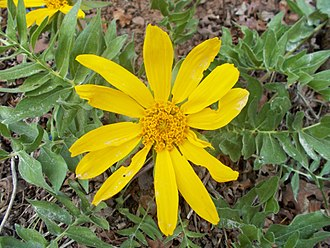
The basal lance-shaped leaves form a clump from a taproot and are 15-30″ long, pinnately lobed, and are covered with long soft hairs. Solitary yellow flower heads are carried on lax leafless stems and are up to 5″ across.
Alternate Name/s: Large-leaved Balsamroot , hairy balsamroot, Idaho balsamroot, cleft-leaf balsamroot
Native Range: Oregon as well as parts of the Rocky Mountain area
Habitat: Sagebrush scrublands, rocky meadows, and conifer forests usually at usually at elevations from 4500 to 7000 feet
Type: Perennial
Height: 12-36″
Bloom Time: Late spring to early summer
Bloom Color: Yellow
Light: Sun to part shade
Soil: Average, medium moist to dry, well-drained
USDA Hardiness Zones: 4 and warmer
Photo Credit: Wikipedia
Arrowleaf Balsamroot (Balsamorhiza sagittata)
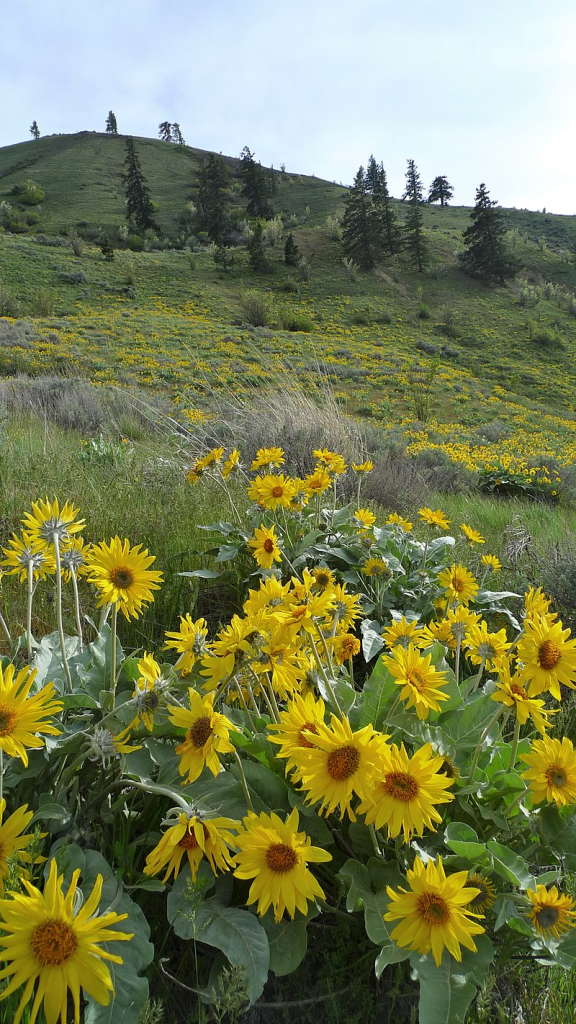
Arrow-shaped basal leaves are carried on petioles 2-18″ long and form silvery gray tufts. Upper stem leaves are linear to elliptic and smaller. All leaves are silvery white to green. Eight to twenty-four hairy, glandular stems arise that are 8 to 24 inches tall and carry 2-3″ wide yellow flower heads from late spring to summer.
Alternate Name/s: Breadroot, Oregon sunflower, spring sunflower
Native Range: Washington, Oregon, and California as well as places in the Rocky Mountain area, Southwest and Midwest.
Habitat: Sandy plains and forest openings at elevations of 4000-8000 ft.
Type: Perennial
Height: up to 31″
Bloom Time: Late spring into summer
Bloom Color: Yellow
Light: Sun to part shade
Soil: Silty to loam, dry to medium moist, well-drained
USDA Hardiness Zones: 4-8
Photo Credit: Thayne Tuason, Wikimedia Commons
The three states of the Pacific coast, Washington, Oregon and California, have a great variety of geography and climate. The key factors uniting these states are the coastline along the Pacific Ocean and the presence of numerous mountain ranges. The area of the Pacific coast includes rainforests as well as semi-arid plateau and deserts. The climate varies with the geography with average annual rainfall ranging from over 130″ to less than 2″. Precipitation can be in the form of rain or snow. Likewise, summer temperatures can be over 110 F in Death Valley and down to -70 F in the mountains.