
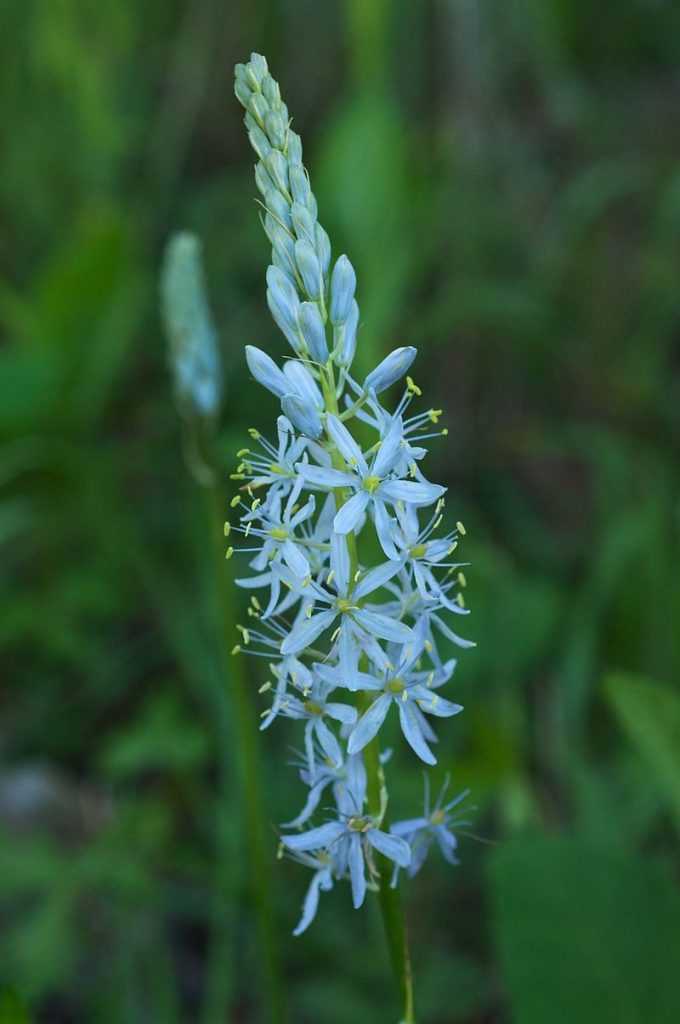
Camassia are perennial bulbous plants in the Asparagus family, Asparagaceae, that also includes yucca, bluebell and spider plant. They are native to the US where they grow in moist meadows across the nation in all major regions except New England. Plants grow 12 to 50″ tall and have a basal rosette of strap-shaped linear leaves that are 8-32″ long, appear in the early spring and tend to wither after flowering. In summer, multiple flowers are carried in terminal racemes above the foliage. Each flower is star-shaped and has six white to pale lilac to deep purple or blue-violet petal-like tepals. The flowers are often good in the vase.
Although Camassias prefer full sun they tolerate partial shade as well as short term wet and clay soil . They are fairly cold-hardy and resistant to pests and diseases. The bulbs produce offsets that can be used to propagate the plants but seed is a possibility too if waiting several years for flowering is acceptable. The genus name, Camassia, comes from the Native American Indian name of kamas or quamash for a genus whose bulb was once used by native Americans and settlers as a food source. Photo Credit: Eric in SF, Wikipedia
The environmental conditions of the Midwest have resulted in at least two species of Camassia native there but they may be native to other regions also. The Camassias described here are native to at least five states in the Midwest.
Prairie Camas (Camassia angusta)
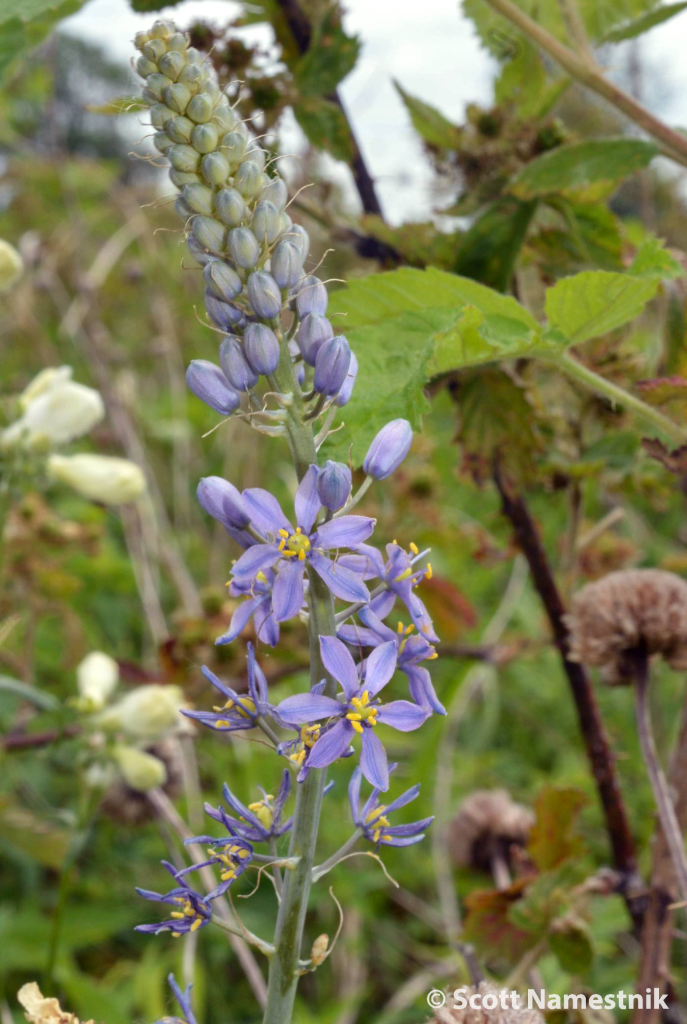
Six to twelve, linear, strap-shaped leaves are up to 14″ long and form an upright to drooping basal clump 18″ across. One or more flowering stalks up to 30″ tall carry 4-12″ long terminal racemes of 20-89 lavender to pale purple flowers. Each flower is 3/4″ in diameter, has 6 tepals surrounding conspicuous stamens with yellow anthers, and attract various insects including butterflies and both long-tongued and short-tongued bees.
Each flower is 3/4″ in diameter, has 6 tepals surrounding conspicuous stamens with yellow anthers, and attract various insects including butterflies and both long-tongued and short-tongued bees.
Alternate Name/s: Prairie hyacinth, wild hyacinth
Native Range: Wisconsin, Michigan, Iowa, Kansas, Missouri, Illinois, Indiana and Ohio as well as areas in the Southwest and Southeast
Habitat: Prairie, savannah, open woodland
Type: Perennial
Height: 24-30″
Bloom Time: Mid to late spring
Bloom Color: White, blue, purple, or violet
Light: Full sun to light shade
Soil: Fertile, humusy, consistently moist, well-drained, acidic
USDA Hardiness Zones: 5-8
Photo Credit: Scot Namestnik, SERNEC
Atlantic Camas (Camassia scilloides)
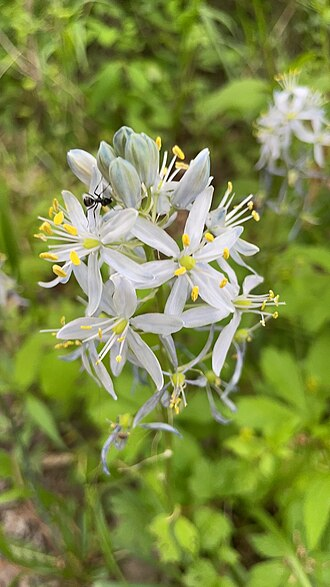
Floppy grass-like leaves are 6-12 inches long and form a low basal rosette up to 18″ wide. Flowering stalks are 18-24″ tall and carry terminal racemes of numerous flowers. Each flower is 3/4-1″ across and has 6 bright yellow anthers surrounded by light blue-violet to almost white tepals that spread widely from the center of the flower. The flowers attract various pollinators including honey bees, bumble bees, and occasionally butterflies.
Alternate Name/s: Wild camas, eastern hyacinth
Native Range: Texas and Oklahoma as well as places in the Midwest, Southeast and Mid-Atlantic
Habitat: Prairies, savannahs, open woodlands, rocky wooded slopes, and limestone glades
Type: Perennial
Height: 8-12″
Bloom Time: Mid to late spring
Bloom Color: Pale blue to whitish
Light: Full sun to partial sun
Soil: Fertile, medium moist, well-drained
USDA Hardiness Zones: 5-9
Photo Credit: Wikipedia
The Midwest includes the states of Ohio, Indiana, Illinois, Iowa, Kansas, Missouri, Michigan, Wisconsin, Minnesota, Nebraska, South Dakota, and North Dakota. The area features lakes, mountains, and vast fertile plains that are the “bread basket” of the nation. The climate of the Midwest has great variations in temperatures with hot humid temperature averaging 85-95 F in summer and winter temperatures often falling below 0 F. Precipitation comes in the form of both rain and snow and varies from 43.6″/year to 18.8″/year.