
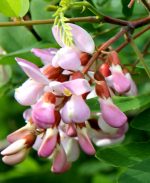
Also known as bristly acacia, this flowering deciduous shrub is native to eastern and central US and is a member of the pea family, Fabaceae, that also includes mimosa, lupine, and alfalfa. It grows 2-10′ tall from a rhizomatous root system and has well-branched, stems often with red bristles. The pinnate compound leaves have 7 to 13 oblong to round leaflets that are 1-2″ long, blue-green at first but turn yellow in the fall. From late spring to mid summer hanging, axillary and terminal racemes appear that are 2-4 ” long and consist of 5-15 rosy pink flowers. Each pea-like flowers is 1″ long, has 5 petals and gives way to a flat seed pods that are 2- 3″ long , contain 3-5 seeds, and covered with purple-brown bristly hairs. Plants are tolerant of drought, poor soil, heat, and air pollution but can become invasive. They are often used for erosion control on slopes, as a hedge or screen in the garden and are suitable for xericscapes and native plant gardens. The genus name, Robinia, honors Jean Robin (1550-1629) the gardener of Kings Henry IV and Louis XIII of France. The specific epithet, hispida, is the Latin word for bristly and refers to the bristles on the plant.
Type: Flowering deciduous shrub
Outstanding Feature: Flowers
Form: Open
Growth Rate: Rapid
Bloom: Hanging racemes of rosey pink 5 petaled flower from late spring to mid-summer
Size: 2-10′ tall
Light: Full sun to partial sun
Soil: Average to lean, medium moist to dry, well-drained
Hardiness: Zones 5-8
Care: Low maintenance
Pests and Diseases: None of significance
Propagation: Seed, division, cuttings; cultivars by budding or grafting
Outstanding Selection: ‘Arrot’