
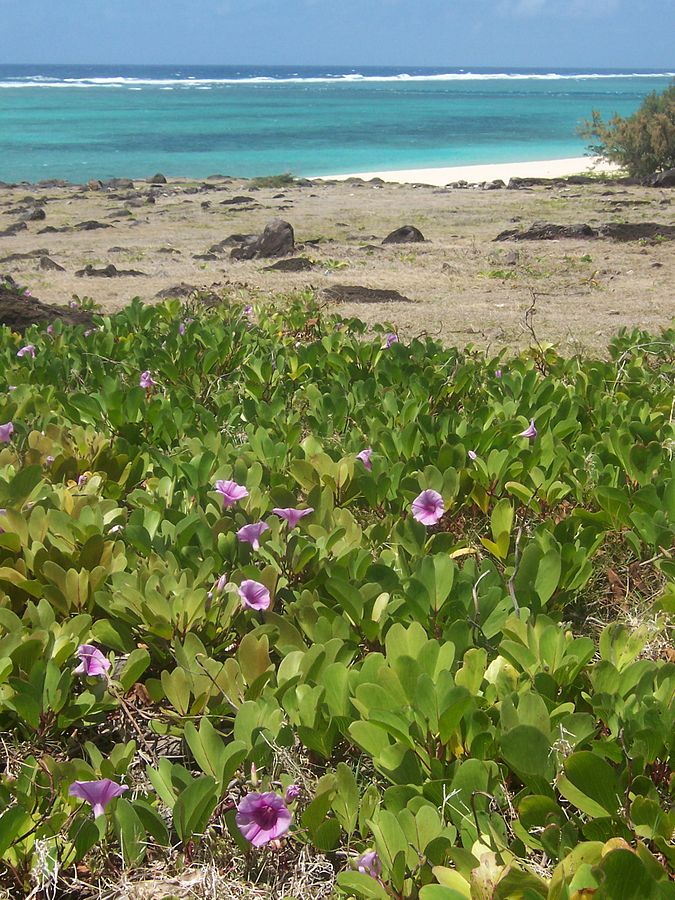
Also called bayhops, beach morning glory, seaside yam and goat’s foot, this evergreen, creeping, perennial vine is native to tropical and subtropical coastal areas around the world, growing especially on upper beaches and dunes. It is a member of the bindweed family, Convolvulaceae, that also includes sweet potato, Hawaiian baby wood rose, and dodder. The plant grows 6-16″ high from a taproot and has a succulent stem. The stem grows up to 100′ long quickly and may form adventitious roots at nodes that are 3- 7″ apart. The dark green leathery leaves are 3-4.75″ long, may be ovate, orbicular, or oblong, and usually have a deeply notched apex that resembles the hoof of a goat, giving rise to the common name, goat’s foot. The petioles are 1-6″ long and may be reddish when young, becoming yellowish-green with maturity. A pair of nectar-producing glands at the juncture of the leaf blade and petiole attracts ants that ward off insects. Leaves and stems contain a white sap that may protect plants from pests. Cymes of one to several flowers are produced in the leaf axils year-round but mostly in warm weather, spring through fall. They are funnel-shaped, up to 2.5″ wide, and have 5 fused petals that are pale pink to lavender to reddish purple petals with a darker rose-purple throat. Like other morning glories, the flowers last only one day, opening in the morning on sunny days and closing by early afternoon. On shady days they may open and close later in the day. Pollinated primarily by bees, but also visited by butterflies, moths, flies, beetles and wasps, the flowers give way to dehiscent capsules that are 0.5 to 0.75 inches long and wide, The capsules are green maturing to gray, and contain 4 rounded to 3-sided seeds that are 0.25 to 0.35 inches long and covered with dense velvety hairs. Railroad vine is tolerant of lean soil, drought, heat, salt spray, wind, and occasional inundations of salt water so is an excellent choice for beach stabilization and dune restoration, as well as for use as a ground cover in seaside, pollinator and native plant gardens. The genus name, Ipomoea, comes from ancient Greek words ἴψ (íps) meaning wormwood, and ὅμοιος (hómoios) meaning resembling, and refers to the coiled, worm-like flower buds of members of this genus. The specific epithet, pes-caprae, are the Latin words meaning foot of a goat, and refer to the shape of the leaves.
Type: Evergreen herbaceous perennial vine
Bloom: Funnel-shaped flowers with 5 fused petals that are pale pink to lavender to reddish purple petals with a darker rose-purple throat, from spring to fall
Size: 6-16″ H x Up to 100′ length
Light: Full sun
Soil: Sandy, lean, dry to medium moist, well-drained; drought tolerant; tolerates occasional salt water inundations
Hardiness: Zones 9-11
Care: Low maintenance; control spread if necessary
Pests and Diseases: Generally healthy but can suffer damage by beetles, scale, mealy bug, slugs, leaf spot and rust.
Propagation: Stem cuttings, division, seed (scarify)
Companion Plants: Sea ox-eye, pink muhly grass, baybean
Photo Credit: B.navez Wikimedia Commons