
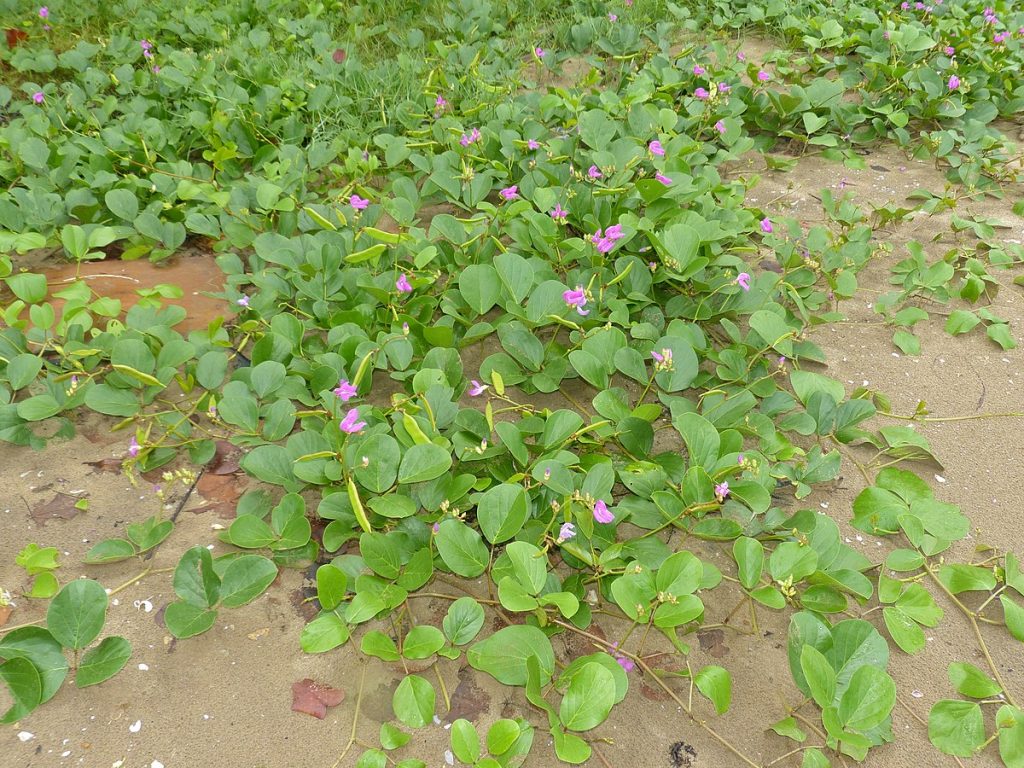
Also known as seaside bean, beach bean, coastal jackbean and Mackenzie bean, this evergreen herbaceous perennial vine is native to cliffs, upper beaches, strands, and dunes of tropical and subtropical coastal regions worldwide. It is a member of the legume family, Fabaceae, that also includes peas, lupines, and black locust. The plant has a thick, fleshy, trailing stems that grow quickly to form mats 6-12″ high and up to 50′ wide. The thick, leathery, trifoliate leaves are ovoid, 2-4″ long, and fold in on themselves when exposed to hot sunlight. Small racemes of pinkish-purple flowers with white centers and 10 mostly fused yellow stamens appear throughout the year with a peak from summer to fall. The 2″ long flowers are axillary, inverted and attractive to a variety of insects but are primarily pollinated by bees. The fruit is a flat, 4-6″ long pod that is green when young but becomes brown and ridged as it matures. The seeds are buoyant and dispersed by sea water. Although the young pods and seeds are edible when cooked they become toxic as they mature on the plant. Beach bean is tolerant of drought, salt spray, wind, and frequent salt water inundations, and is valued for dune restoration as well as for a ground cover in large coastal gardens. It is not recommended, however, for small areas because it can become aggressive. The genus name, Canavalia, is from the Malayalam word Kanavali, the local name for the plant in southern India. The specific epithet, rosea, is the Latin word meaning pink and refers to the flower color.
Type: Evergreen, perennial, herbaceous vine
Bloom: Small racemes of 2″ long pinkish-purple flowers with white centers year round with peak from summer to fall
Size: 6-12″ H x 10-50′ W
Light: Full sun
Soil: Sandy, moderately moist to dry, well-drained
Hardiness: Zones 9-11
Care: Low maintenance
Pests and Diseases: None of significance
Propagation: Seed (scarify or soak for several hours), cuttings
Companion Plants: Sea ox-eye, railroad vine, beach sunflower
Photo Credit: Bernard DUPONT Wikipedia Commons