
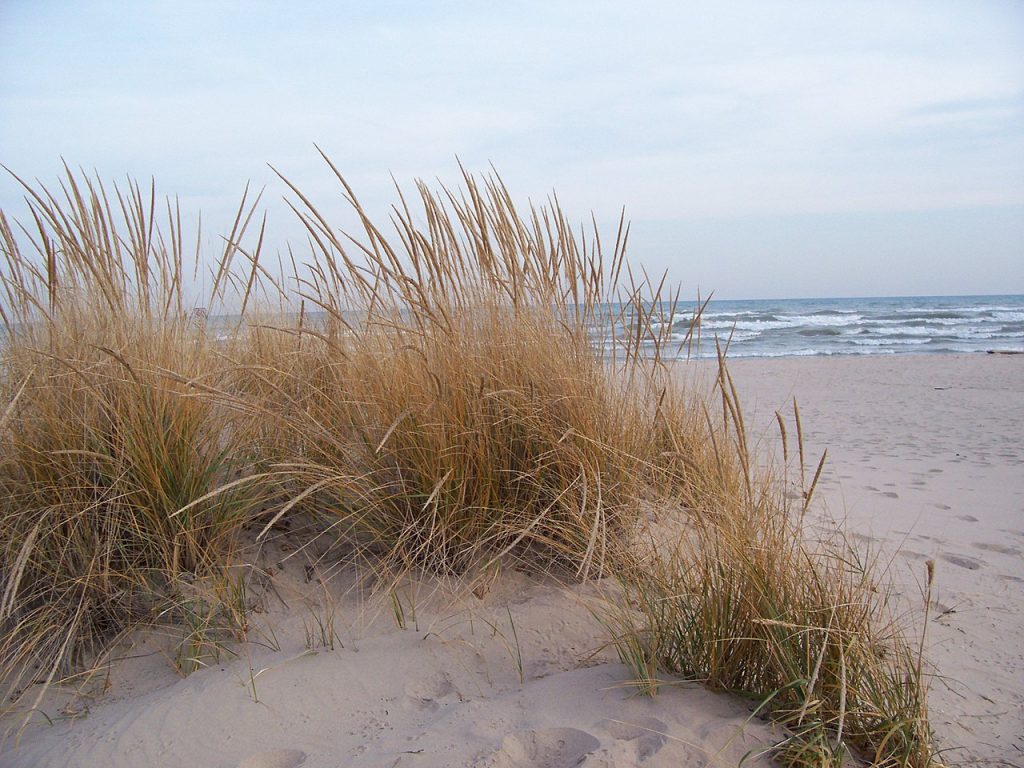
Also known as American marram grass, this cool season perennial grass is native to sand dunes along the coasts of the Great Lakes and the Atlantic Ocean as far south as North Carolina. It is a member of the grass family, Poaceae, that also includes rice, corn, and bamboo. The plant grows 1-3 ‘ tall and spreads quickly by rhizomes to form colonies 6-10’ wide. The erect stems are hairless and unbranched. The long stiff leaves originate mostly from the base, and have rolled edges and a deeply furrowed upper surface with a smooth underside. In early summer, a spike-like panicle appear that is up to 10 inches long and consist of short-stalked, overlapping and tightly crowded spikelets up to 1/2″ long, each with one floret. The seed heads appear in in late summer but few seeds are viable. The plants provide cover and nesting for birds and other vertebrates but are especially valued for dune restoration as they thrive under conditions of shifting sand, sand burial, high winds and salt spray. The genus name, Ammophilia, comes from the Greek words ἄμμος (ámmos), meaning sand, and φίλος (philos), meaning friend, and refers to the favored habitat of the plant. The specific epithet breviligulata, is from the Latin words brevis, meaning short, and ligula, meaning tongue, and refers to the length of the structure found at the junction of the blade and sheath of the leaf.
Type: Cool season perennial grass
Bloom: Spike-like panicles up to 10″ long in early summer
Size: 1-3′ H x 6-10 ‘ W
Light: Full sun
Soil: Sandy, dry to medium moist, well-drained; highly salt tolerant
Hardiness: Zones 4-9
Care: Low maintenance; does not take foot traffic well
Pests and Diseases: Nematodes
Propagation: Division (most seeds are not viable)
Companion Plants: Blanket flower, seaside goldenrod,
Outstanding Selections: ‘Cape’
Photo Credit: Royalbroil Wikipedia
 Karen Meyers