
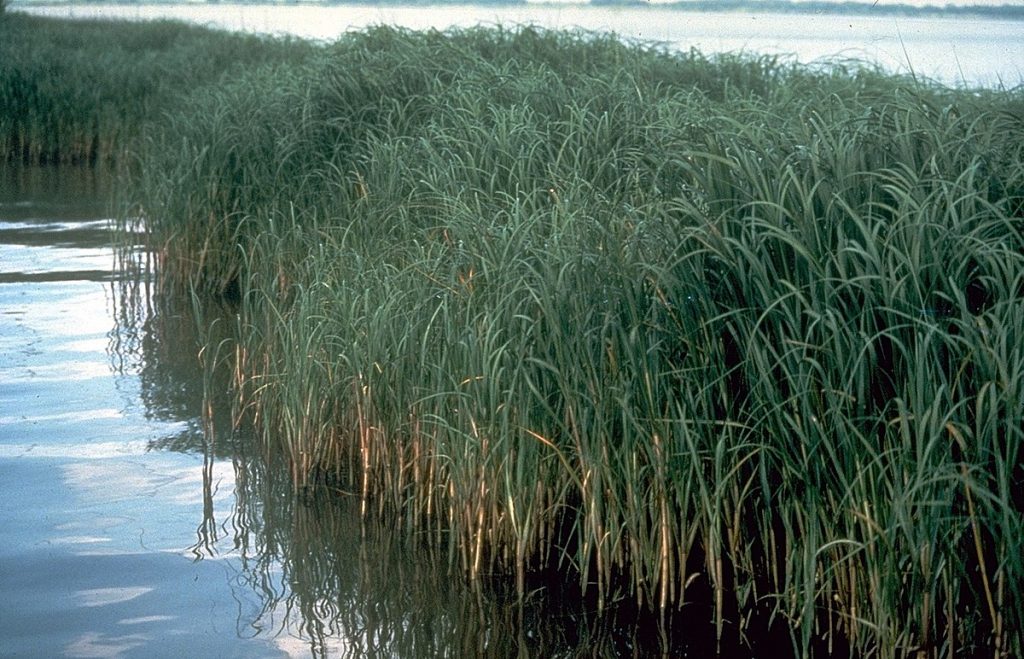
Also known as saltmarsh cordgrass, and salt-water cordgrass, this deciduous perennial grass is native to intertidal wetlands especially estuarian salt marshes of the Gulf Coast and Atlantic Coast from Newfoundland, Canada, south to northern Argentina. It is a member of the grass family, Poaceae, that also includes rice, corn, and bamboo. The plant has a rhizomatous root system and forms dense colonies 1′ -8′ tall depending on the zone of the salt marsh in which it grows. The smooth, hollow stems carry flat slender leaf blades 8-24″ long that taper and bend down at the tips. The leaves are yellow-green in the spring and summer, turning brown in the fall and winter, and have glands that secrete excess salt. From mid to late summer, branched flowering spikes up to 16″ long appear carrying white to yellowish-green flowers on one side of the stem. Smooth cord grass has been valued for its ability to accumulate sediment and has been used to control shoreline erosion. The plant provides habitat for birds, small mammals, and aquatic wildlife such as marsh periwinkles, ribbed mussels and fiddler crabs, and its roots are a favorite food of snow geese. The plant was introduced to the Pacific Coast and has become invasive there. The genus name, Spartina, comes from the Greek spartine, meaning a cord made from Spartium junceum (Spanish broom), probably referring to the tough leaves and stems. The specific epithet, alterniflora, comes from the Latin word alternus meaning one after another, and Flora, the name of the goddess of flowers.
Type: Deciduous perennial grass
Bloom: Branched spikes of small white to yellowish-green flowers from mid to late summer
Size: 1-2′ H in high marsh, up to 8′ tall in low marsh
Light: Full sun
Soil: Sand, to clay, wet; thrives on saline inundation and soil
Hardiness: Zones 5-11
Care: Low maintenance
Pests and Diseases: None of significance
Propagation: Division, seed
Companion Plants: Glasswort, beachwort, sea lavender
Outstanding Selections: None available
Photo Credit: USDA Wikimedia Commons
 Karen Meyers