
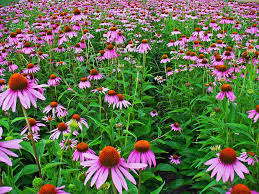
Purple coneflowers are long-lived herbaceous perennials and members of the aster family, Asteraceae, that also includes daisy, yarrow, and lettuce. They are native to eastern and central North America, where they grow in wet to dry prairies and open wooded areas. Plants grow 1-5′ tall with erect, usually unbranched stems, and both basal and stem leaves that are hairy and linear to ovate. The inflorescence is a flowerhead consisting of cone-shaped center of 200-300 dark disk florets surrounded by 8-21 ray florets that are usually drooping (reflexed) and may be white, pink, purple, or in one case, yellow.
Purple coneflower prefers rich, well-drained soil, tolerates poor, rocky soil, but is intolerant of wet soil. Full sun is best in cool areas but partial shade is preferred where summers are hot. Plants are susceptible to fungal diseases and aphids. Propagation is by seed, cuttings or division. The flowerheads are popular in dried and fresh arrangements and are attractive to pollinators including hummingbirds, butterflies and bees. The seeds are attractive to birds. Historically, the plant has been used medicinally.
The genus name, Echinea, is derived from the Greek word ἐχῖνος (ekhinos), meaning hedgehog, and refers to the appearance of the spiny central disk.
Photo Credit: Wikipedia
The environmental conditions in New England have resulted in at least two species of purple coneflower native to New England but they may be native to other areas in the US too. The purple coneflowers described here are native to at least 3 states in New England.
Pale Purple Coneflower (Echinacea pallida)
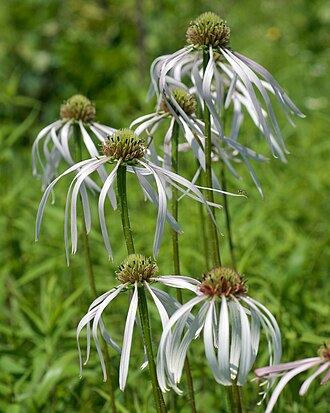
Hairy, green to purple tinged stems with sparse branching carry lanceolate, hairy leaves 4-10″ long, mostly on their lower third. Single, terminal flowerheads consist of a prominent coppery brown center of disk florets with white pollen surrounded by 12-20 slender, drooping, pale pink to purple ray florets. The ray florets are up to 3″ long, less than 1/4″ wide, and are very reflexed.
Alternate/s Names: None
Native Range: Connecticut, Massachusetts, and Maine as well as places in the Southwest, Midwest, Southeast, and Mid-Atlantic
Habitat: Dry and mesic prairies, open dry rocky woods, limestone glades, oak savannas, pinelands, old fields
Type: Perennial
Height: 18-36″
Bloom Time: Early summer
Bloom Color: Pale purple to pink
Light: Full sun
Soil: Sandy, dry to medium moist, well-drained
USDA Hardiness Zones: 3-10
Photo Credit: Wikipedia
Eastern Purple coneflower (Echinacea purpurea)
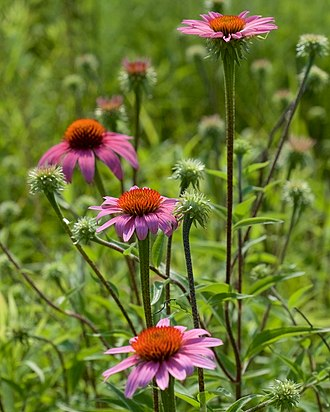
Brownish green stems are mostly unbranched and carry leaves that are 3-6″ long and have serrated margins and 3 or 5 distinct veins. The solitary, terminal flowerheads are up to 5″ across and consist of a conical center of orange-brown disk florets with yellow pollen surrounded by 1-2 rows of 15-20 pink to purplish ray florets that curve downward with maturity.
Alternate/s Names: Purple coneflower, hedgehog coneflower
Native Range: Vermont, Massachusetts and Connecticut as well as places in the Rocky Mountain area, Midwest, Southeast and Mid-Atlantic
Habitat: Open woodlands, woodland edges, thickets, moist prairies, meadows, barrens, and savannas
Type: Perennial
Height: 2-5′
Bloom Time: Summer into fall
Bloom Color: Purple, rarely white
Light: Full sun to light shade
Soil: Average, dry to medium moist, well-drained
USDA Hardiness Zones: 3-8
Photo Credit: Wikipedia
The New England area includes Maine, New Hampshire, Vermont, Massachusetts, Rhode Island and Connecticut. The area offers diverse geography with rivers, lakes, forests, mountains, and coast lines on both the Atlantic Ocean and Long Island Sound. It has four distinct seasons that provide environmental conditions for at least two native purple coneflowers. The winters are long, cold, and heavy snow is common from December to February. Summer is short with temperatures between 80 and 85 F. Precipitation averages about 45″ as rain and 60-90″ as snow.