
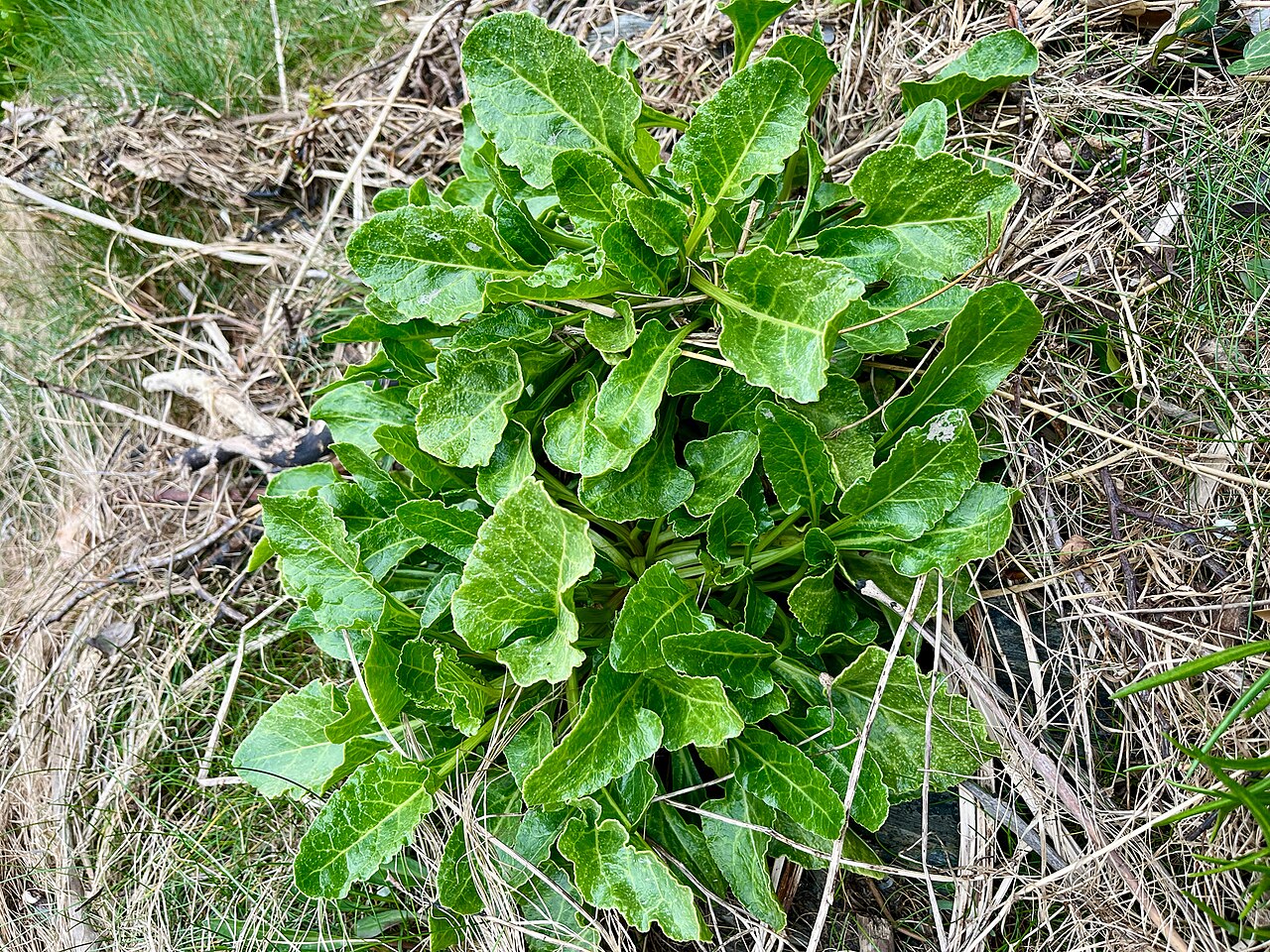
Also known as wild spinach, this hardy herbaceous perennial is native to coastal regions of Europe, North Africa, and southern Asia where it is found on shingle beaches, sea cliffs, drift line of saltmarshes, coastal walls, and well-drained sunny soil. It is a member of the amaranth and goosefoot family, Amaranthaceae, and is the wild ancestor of cultivated beets such as garden beetroot, Swiss chard, and sugar beet. The plants grow 31″ tall and have glossy dark green leaves that are leathery, and have smoothed margins. The upper leaves are oval and narrow while the lower leaves are wavy and roughly triangular. In summer, thick fleshly grooved stems bear tight clusters of 2-11 tiny green flowers in leafy spikes. The flowers lack petals, are wind pollinated, and have 5 sepals that thicken, harden and curve inward around the fruits that follow, fusing adjacent flowers to form corky seedballs. Each seedball has 2-5 small glossy dark red-brown, lens-shaped seeds. Sea beets are valued for their resistance to drought, salinity and wind as well as for their culinary attributes. It is a good choice for coastal gardens. The genus name, Beta, may come from Celtic root word (bett), meaning red and referring to the deep red-pigmented roots or stems of some varieties. The specific epithet, vulgaris, is the Latin word meaning common or ordinary, and is used to denote species that were widely known. The subspecies name, maritima, is the Latin word meaning of the sea and refers to the usual habitat of the plant in coastal areas.
Type: Hardy herbaceous perennial
Bloom: Tiny, green petaless flowers produced in cluster in summer.
Size: 31″ H x 12-20″ W
Light: Full sun but tolerates light or partial shade
Soil: Deep, well drained, neutral to slightly alkaline
USDA Hardiness: Zones 4-9 (does not tolerate high summer temperatures well)
Care: Cut back flowering stalks to encourage leaf production
Pests and Diseases: Generally healthy but can be damaged beet leaf miners, aphids, flea beetles, caterpillar, downy mildew and leaf spot.
Propagation: Seed, root or crown division in early spring.
Companion Plants: sea thrift (Armeria maritima), sea holly (Eryngium spp.), and sea lavender (Limonium spp.)
Photo Credit: Wikipedia
 Karen
