
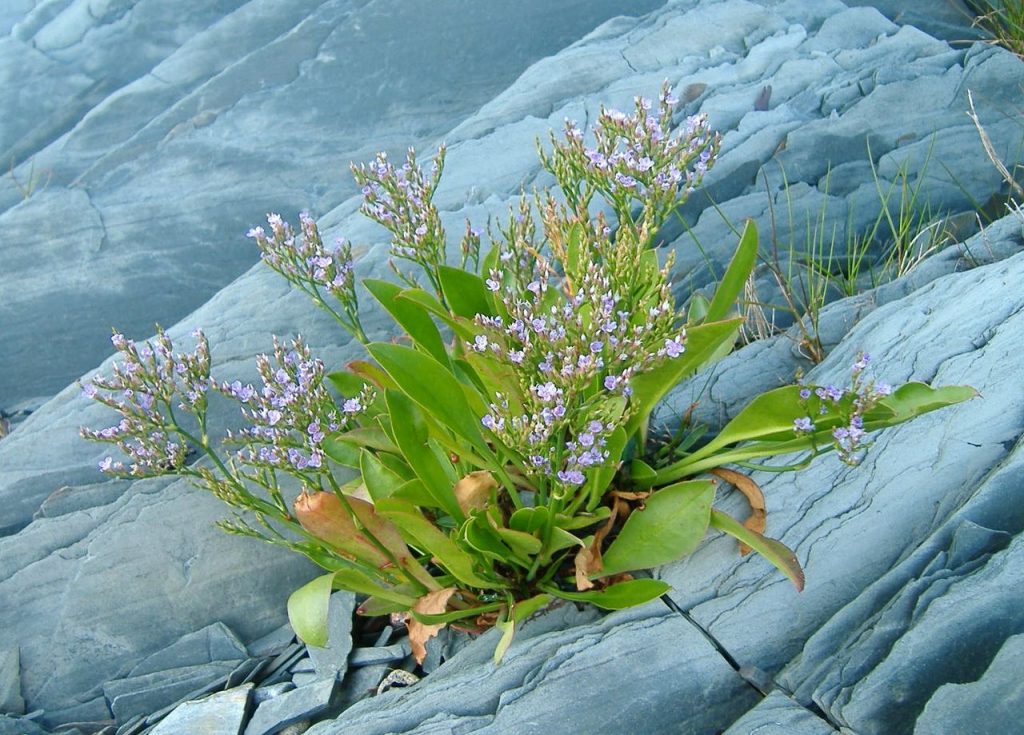
Also known as canker root, ink root, marsh root, lavender thrift and seaside thrift, the herbaceous perennial is a member of the leadwort family, Plumbaginaceae. It is native to maritime habitats of the eastern shores of North America from Maine to Florida, along the Gulf Coast from Florida to the Texas coast, and south to Mexico where it grows on beaches and in brackish or salt marshes and flats. The plant grows 1-2′ tall and has a stiff, green to reddish, highly branched stem and ovate, green, hairy leaves that are leathery, 7-8″ long, and form a rosette at the base of the main stem. Airy clusters of small light purple flowers appear from late summer to early fall. The flowers are 1/8 across, grow only on one side of a branch and have white sepals that may persist after the petals have disappeared. They attract butterflies and other pollinators and are popular in fresh and dried arrangements, but are over harvested in some areas. Tolerant of wet soil and salt, Carolina sealavender is a good choice for coastal gardens. The genus name, Limonium, is from the ancient Greek word λειμών (leimṓn) meaning meadow, referring to the habitat of many species. The specific epithet, carolinanum, is the Latinized form of Carolina suggesting one of the areas where the plant is native.
Type: Herbaceous perennial
Bloom: Clusters of small purple flowers with white sepals from mid summer to early fall
Size: 1-2′ H x 1-1.5″ W
Light: Full sun
Soil: Clay, loam, or sand, moderately moist, well-drained, but tolerates occasional wet soil and salt
Hardiness: Zones 5-11
Care: Low maintenance
Pests and Diseases: None of significance
Propagation: Seed, division in spring
Companion Plants: Saltwort, glasswort, blackneedle rush
Outstanding Selections: None available
Photo Credit: Wikipedia