
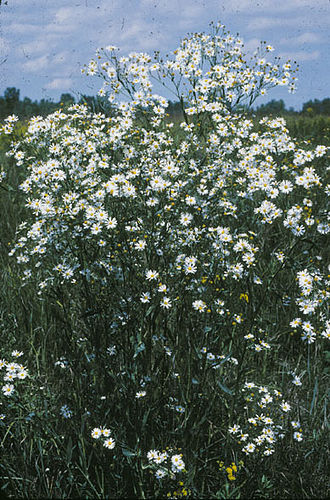
Boltonia is a genus of herbaceous perennials in the aster family, Asteraceae, that also includes daisy, sunflower and lettuce. The leaves are lance-like and the daisy-like flowerhead are small, carried in clusters, and composed of numerous white to pink or purple ray florets surrounding a yellow center of disc florets. Most Boltonias are native to the US, easy to grow, but are too big and lanky to include in a formal garden. At least one very fine cultivar of Boltonia asteroides , ‘Snowbank” is available and popular for formal gardens. The genus name, Boltonia, honors James Bolton (1735-1799), English botanist. Photo Credit: Wikipedia
The environmental conditions in the Southwest have resulted in at least 2 native species of Boltonia native but are native to other regions also. The Boltonia described here are native to at least two states in the Southwest.
White Doll’s Daisy (Boltonia asteroides)
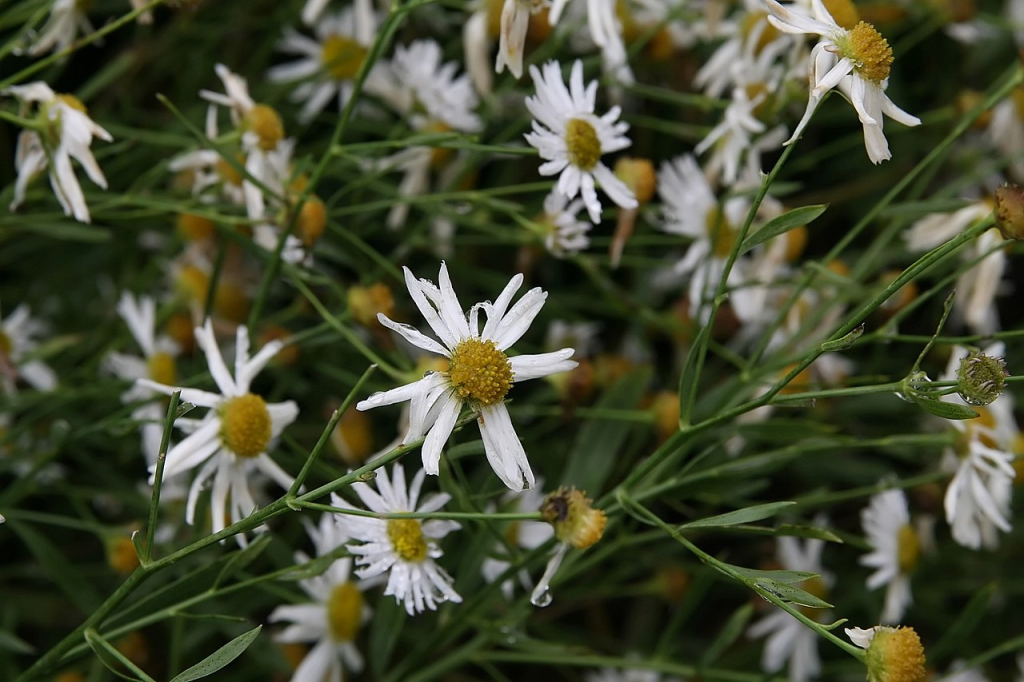
Stem are usually branched and carry linear gray-green leaves up to 5″ long. Flowerheads are borne in large, loose panicles. Each flowerhead is .75-1.25″ across and consist of 20-60 white to bluish ray florets, sometime pink tinged or violet, surrounding a center of yellow disc florets. White doll’s daisy is generally considered too large, floppy and weedy for inclusion in a formal garden but desirable in a wildflower garden for its abundant bloom late in the season.
Alternate Name/s: False chamomile, false aster
Native Range: Texas and Oklahoma as well places on the Pacific Coast, and in the Rocky Mountain area, Midwest, Southeast, Mid-Atlantic, and New England
Habitat: Floodplains, wet prairies, wet meadows, thickets, marshes, stream banks, shorelines and pond edges
Type: Perennial
Height: 16″ to 78″
Bloom Time: Late summer to frost
Bloom Color: White to pink tinged or violet
Light: Full sun to part shade
Soil: Average, medium moist to dry, well-drained
USDA Hardiness Zones: 3-10
Photo Credit: Wikipedia
Smallhead Doll’s Daisy (Boltonia diffusa)
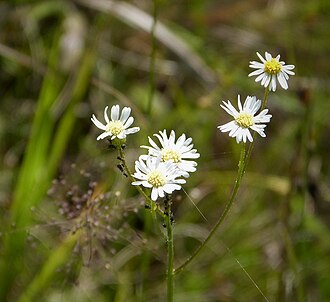
Erect spindly stems are branched and carry linear leaves less than 1″ long and flowerheads about 1/2″ wide. The flowerheads are carried in very loose panicles and consist of 20-40 white to lilac ray florets surrounding a yellow center of 50-135 disc florets. The flowerheads are attractive to pollinators and the plants are suitable for native plant, wildflower, pollinator, and wetland gardens.
Alternate Name/s: None
Native Range: Texas and Oklahoma as well as places in the Southeast and Midwest.
Habitat: Moist to wet
Type: Perennial
Height: 12″- 6′
Bloom Time: Summer to fall
Bloom Color: White
Light: Full sun
Soil: Average, medium moist, well-drained
USDA Hardiness Zones: 5-9
Photo Credit: Wikipedia
For the purpose of this article, the Southwest includes the states of Texas, Oklahoma, New Mexico and Arizona. Other states often associated with the Southwest are included in other geographic areas. The key factor linking these four states is aridity. The area includes high dry plains and true deserts as well as spurs of the Rocky Mountains. Only Texas has a coast on the ocean which brings more precipitation and humidity to east Texas and Oklahoma than elsewhere in the area. In addition to the ocean, the Rio Grande and Colorado Rivers are significant water features in the area. Although temperatures in the mountains can be cool, most of the area experiences hot temperatures for a long period each year.