
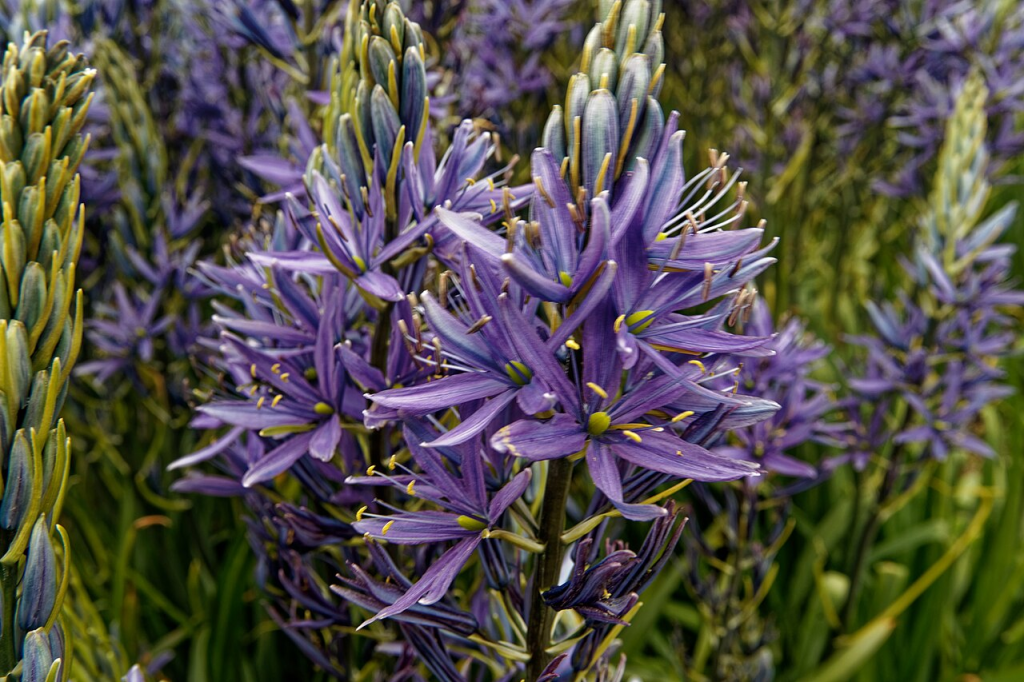
Camassia are perennial bulbous plants in the Asparagus family, Asparagaceae, that also includes yucca, bluebell and spider plant. They are native to the US where they grow in moist meadows across the nation in all major regions except New England. Plants grow 12 to 50″ tall and have a basal rosette of strap-shaped linear leaves that are 8-32″ long, appear in the early spring and tend to wither after flowering. In summer, multiple flowers are carried in terminal racemes above the foliage. Each flower is star-shaped and has six white to pale lilac to deep purple or blue-violet petal-like tepals. The flowers are good in the vase.
Although Camassias prefer full sun they tolerate partial shade as well as short term wet and clay soil . They are fairly cold-hardy and resistant to pests and diseases. The bulbs produce offsets that can be used to propagate the plants but seed is a possibility too if waiting several years for flowering is acceptable. The genus name, Camassia, comes from the Native American Indian name of kamas or quamash for a genus whose bulb was once used by native Americans and settlers as a food source. Photo Credit: Txllxt TxllxT, Wikimedia Commons
The environmental conditions in the in the Rocky Mountain area have resulted in at least three species of Camassia native there but they may be native to other regions also. The Camassias described here are native to at least one state in the Rocky Mountain area.
Cusick’s Quamash (Camassia cusickii)
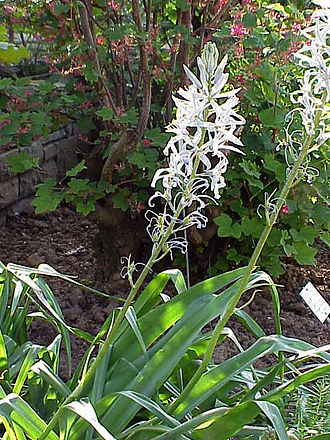
Linear, strap-shaped leaves 10-20″ long form a basal rosette in spring. A terminal raceme 1.5-2.5′ tall carries up to 100 various shades of blue to cream or white flowers with showy yellow anthers. Each flower is 3/4-1″ across and consists of 6 oblong tepals that spread widely, forming a star-shape, and are attractive to pollinators including butterflies and hummingbirds. Unlike other species of Camassia, the bulb-like root of C. cusickii was not used as a food source by Native Americans probably because it is slimy and has a bitter taste.
Alternate Name/s: Cusick’s camas
Native Range: Idaho as well as Oregon
Habitat: Pond edges, damp meadows at subalpine and alpine elevations
Type: Perennial
Height: 24-30″
Bloom Time: April to May
Bloom Color: Sky blue, cream, white
Light: Full sun to part shade
Soil: Fertile, consistently moist, well-drained soils, acidic
USDA Hardiness Zones: 3-8
Photo Credit: Wikipedia
Great Camus (Camissia leichtlinii)
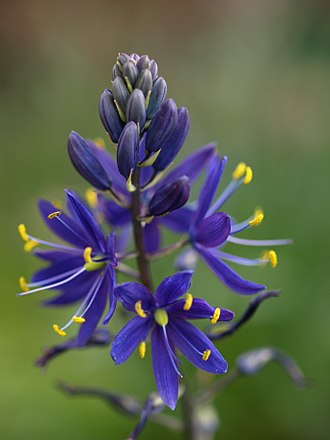
Long narrow leaves form a sizable cluster of basal leaves. Terminal racemes carry numerous star-shaped flowers above the leaves. The flowers are 2″ across and have six pale to deep lavender-blue tepals surrounding a green center with yellow anthers.
Alternate Name/s: Large Camas
Native Range: Nevada as well as areas on the Pacific Coast.
Habitat: Wet meadows, woods, prairies, moist hillsides, and streamside areas; wet conditions may dry up in late spring
Type: Perennial
Height: 24-48″
Bloom Time: Late spring
Bloom Color: White, ivory, blue or purple, most with yellow anthers
Light: Full sun to partial shade
Soil: Fertile, moist
USDA Hardiness Zones: 4-8
Photo Credit: Wikipedia
Common camas (Camassia quamash)
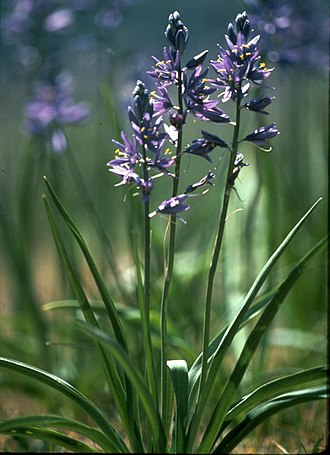
Up to nine linear, grass-like leaves form a basal clump. The leaves are 4-24″ long and may have a pale, waxy coating. Terminal racemes carry numerous star-shaped flowers that are 1″ across and have 6 pale to deep blue to violet tepals. The lowest of the 6 tepals curves outward and downward away from the others.
Alternate Name/s: Kwetlal, small camas, camas, common camash, quamash, blue camas, prairie camas, eastern camas, small-flowered camas, dark camas
Native Range: Idaho, Montana, Wyoming, Utah and Nevada as well as sites on the Pacific Coast
Habitat: Meadows, swales, depressions in prairies, and slopes that are moist in early spring but become dry by late spring
Type: Perennial
Height: 8-36″
Bloom Time: Mid to late spring
Bloom Color: Pale to deep blue or violet
Light: Full sun to partial shade
Soil: Humusy, consistently moist, well-drained
USDA Hardiness Zones: 4-8
Photo Credit: Wikipedia
Six states are included in the Rocky Mountains area: Montana, Wyoming, Idaho, Colorado, Utah, and Nevada. The geography is diverse and includes mountains, plains, and deserts, and the climatic conditions are variable and vary with the geography. Low annual rainfall and high temperatures are typical of some parts of the area, while snowfall and low temperatures are found in other parts and the mountains of all of these states. Photo Credit: Wikipedia