
 Native to Eurasia, this short lived herbaceous perennial is also known as catmint. It was used by the ancient Romans as both a culinary and medicinal herb and in the 9th century AD was listed as one of 23 plants grown by Walafrid Strabo whose garden may be a physic garden. It is also recommended for the gardens of Charlemagne but not mentioned in the plans for the physic garden in the St.Gall monastery in Switzerland.
In the Middle Ages, the monks might have used catnip to treat fevers, colds, sore throat, flu, colic, gastrointestinal disorders, rheumatism, leprosy, and as a relaxant. Other historic uses include the treatment of restlessness, nervousness, hysteria, sleeplessness, bruises, diarhea, menstrual disorders, and infertility. Catnip is also used as a culinary herb, insect repellant, and cat stimulant.
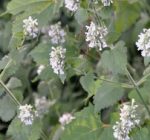
Catnip has a rhizomatous root system and has lightly green, softly hairy, stem that is square in cross section. The ovate, gray-green leaves are 2-3″ long and have a heart-shape base , coarsely toothed margins, and are covered with whitish down, especially on the underside. They are pungent and have an scent like a misture of thyme and oregano. Spikes of tubular flowers appear in late summer and are two lipped, 1/4-1/2″ long, and white with purple-pink spots. They are attractive to butterflies and bees.
Plants are coarse and not particularly ornamental but are well worth growing for their leaves which when dried stimulate about 70% of domestic and wild cats to amusing antics. Catmint likes full sun to part shade and average, medium moist, well-drained soil in USDA Hardiness zones 3-9. They are healthy and have few pest or disease problems. Propagation is by cuttings or seed.
The genus name, Nepeta, proabably honors Nepe, an ancient Etruscan city now known as Tuscia in Lazio, Italy, an area where the plant grows abundantly. The specific epithet, cataria, is derived from the Latin word catus, meaning cat, and refers to the attraction that cats have for the plant.