
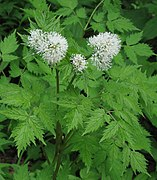
Actea is a genus of herbaceous perennials in the buttercup family, Ranunculaceae, that also includes anemone, monkshood, and delphinium. They are native to subtropical, temperate and subarctic regions of Europe, Asia and North America where they are often found in forests, woodland openings, and deciuous woods. Growing from a thick rhizome, plants have one or more branching stems, large, pinnately divided leaves with toothed leaflets, and clusters of small fluffy white flowers that may attract pollinators. The fruit is a white, red, or purplish-black berry with a black dot which has led to the common name, “doll’s eyes”. The whole plant is poisonous, especially the berries, but birds are not affected by the poison and may eat the berries. Acteaes like part shade and humusy, consistently moist, well-drained soil. They have no significant pests or diseases and are propagated by division or seed.
The genus name, Actea, is derived from the Greek name for elder, Ἀκταία, (Actaia) because the leaves are similar in appearance.
Photo Credit: Robert Flogaus-Faust, Wikimedia Commons
The environmental conditions in the Rocky Mountain area have resulted in at least 1 native species of Actea although it is native to other areas in the US too. The Actea described here is native to 6 Rocky Mountain states.
:
Red Baneberry (Acteae rubra)
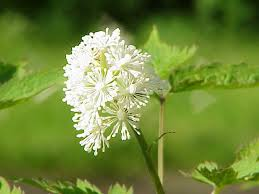
Leaves form bushy clumps of foliage and are twice divided with 3 or 5 leaflets in each group. Leaflets are up to 2″ long, hairy, and are coarsely toothed and sometimes lobed. The flowers appear in rounded clusters about 2″ across on the ends of long stems above the foliage. Each flower is about 1/4″ wide and has 4-10 white, petal-like sepals surrounding a cluster of white tipped stamens that are longer than the sepals. The fruit is an attractive green berry that ripens to red and is poisonous.
Alternate Name/s: Coral berry, rattlesnake herb, snakeberry
Native Range: Idaho, Montana, Wyoming Colorado, Utah, and Nevada as well as on the Pacific Coast, and in the Midwest, Southwest, Mid-Atlantic, and New England
Habitat: Moist, woods and thickets, along stream banks and in swamps
Type: Perennial
Height: 1-3′
Bloom Time: Late spring to early summer
Bloom Color: White
Light: Part shade
Soil: Humusy, consistently moist, well-drained
USDA Hardiness Zones: 3-7
Photo Credit: Wikipedia
Six states are included in the Rocky Mountains area: Montana, Wyoming, Idaho, Colorado, Utah, and Nevada. The geography is diverse and includes mountains, plains, and deserts, and the climatic conditions are variable and vary with the geography. Low annual rainfall and high temperatures are typical of some parts of the area, while snowfall and low temperatures are found in other parts and the mountains of all of these states.