
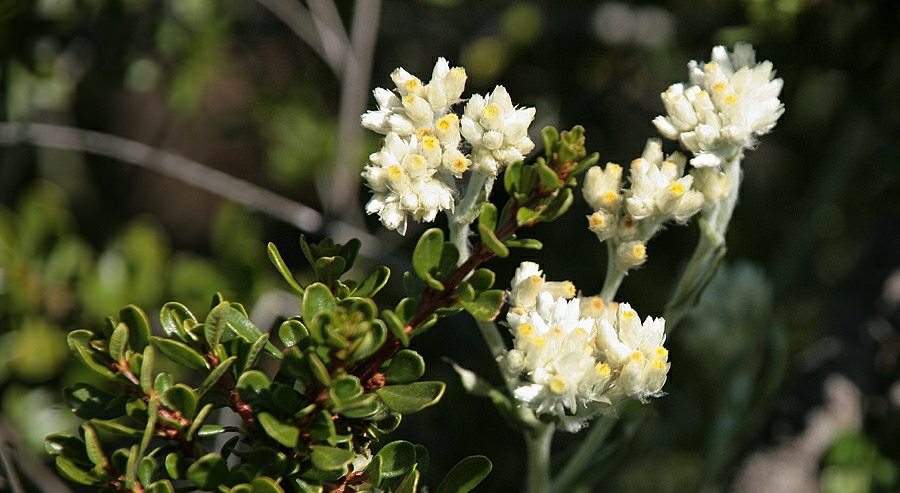
Also called two-color rabbit tobacco, Bioletti’s rabbit-tobacco, and Bioletti’s cudweed, this herbaceous perennial is native to mostly coastal areas of California where it grows in chaparral, coastal scrubland, and on sand dunes. It is a member of the aster family, Asteraceae, that also includes sunflower, goldenrod and yarrow. The plant grows 1-4′ tall and has a tap root, woody base, and several hairy white stems. These stems are branched at the top and carry narrowly ovate leaves. The leaves are up to 2.75″ long, clasp the stem, and are green above and woolly gray below. The stems and leaves are covered with small glandular hairs that are sticky to the touch and have a strong citrus odor. In winter and spring, flat, terminal, 6″ wide clusters of 25-50 egg-shaped flowerheads appear. Each flower head consists of a center of yellowish brown pistils surrounded by an urn-shaped involucre of white or pale yellow, scale-like phyllaries that persist as dry papery “petals”. Bicolor everlasting goes dormant during the summer drought and reappears with the winter rains. It is an important food source for American Lady caterpillars and is suitable for an informal area or native plant garden but has the potential for being invasive. The genus name, Gnaphalium, comes from the Ancient Greek γναφάλλιον (gnaphállion) meaning flock of wool. The specific epithet, bicolor, is the Latin word meaning two colors and refers to the different colors of the top and bottom surfaces of the leaves.
Type: Herbaceous perennial
Bloom: Clusters of 25-50 egg-shaped flowerheads consisting of a center of yellowish brown pistils surrounded by an urn-shaped involucre of white or pale yellow, scale-like phyllaries; in winter and spring
Size: 1-4′ H
Light: Full sun
Soil: Sandy, dry to medium moist, well-drained
Hardiness: Zones 8-10
Care: Low maintenance
Pests and Diseases: None of significance
Propagation: Seed
Companion Plants: Deer grass (Muhlenbergia regens), California fuchsia (Epilobium canum), bush sunflower(Encelia californica)
Photo Credit: NatureShutterbug Wikimedia Commons