
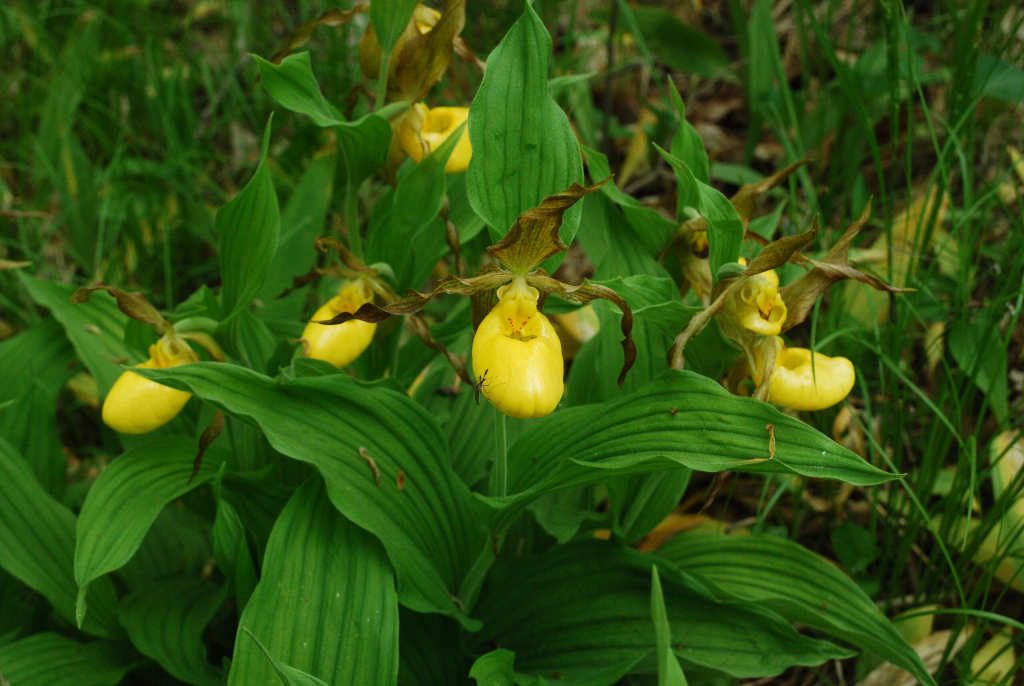
Also known as slipper orchids, moccasin flower, camel’s foot, squirrel foot, steeple cap, Venus’ shoes, and whippoorwill shoe, lady slipper orchids are a member of the orchid family, Orchidaceae, that is one of the two largest plant families and includes the vanilla plant. Most lady’s slipper orchids grow in temperate and subtropical climates of the Northern Hemisphere and are found in such habitats as moist woods, wetlands, and rocky outcrops. Plants are perennial, mostly terrestrial, and grow from a short hefty rhizome. Most slipper orchids have one or more erect stems 6-30″ tall, carrying 2-12 hairy leaves that are ovate to elliptic, to lanceolate, 1.5-10″ long, and pleated longitudinally. One to three (but up to 12) flowers appear at the tops of the leafy stems. The flowers have a showy inflated pouch (the slipper) that is yellow, white or pink and may be tinged or marked with other colors, inside and/or out. Sepals and petals are often the same color ranging from white to green to brown, and may be spirally twisted. Bees are the most common pollinators but other insects may also be involved.
Most lady’s slippers prefer cool temperatures, part shade and moist soil, and are dependent on special soil fungi to complete their life cycle. Slugs are an occasional problem and shoot rot can occur if plants are watered excessively during their dormant period. Lady slippers are difficult to propagate and to grow in the garden and most harvested from the wild will die when transplanted. A few nurseries specialize in growing lady’s slippers and a limited number of species are available.
The genus name, Cypripedium, is derived from ancient Greek words Κύπρις (Kúpris), referring to the Greek goddess Aphrodite, and πέδιλον (pédilon), meaning sandal.
Photo Credit: Wikipedia
The environmental conditions in the Southeast have resulted in at least six species of lady’s slippers native to the Southeast but may be native to other places in the US too. All the lady’s slippers described here are native to at least one state in the southeast.
Moccasin Flower (Cypripedium acaule)
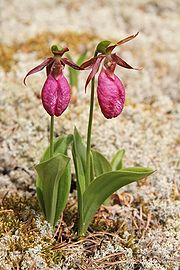
The two green basal leaves are elliptical, 3.5-9″ long, and have conspicuous parallel veins and a finely bristled texture. A leafless bristly stem usually bears a single flower with a large, showy pouch-like lower lip 1.5-2.5″ long. The lip is rich to pale pink with darker veining, sometimes almost white, and has a center groove running down the front. The sepals and petals are lance-shaped and greenish brown. Plants are very difficult to propagate and grow.
Alternate Name/s: Pink Lady’s Slipper, stemless lady’s slipper, two-leaved lady’s slipper
Native Range: Alabama, Georgia, South Carolina, North Carolina, Tennessee, Kentucky, Virginia, and West Virginia as well as parts of the Midwest, Mid-Atlantic and New England
Habitat: Pine or oak woodlands
Type: Perennial
Height: 6-24″
Bloom Time: Mid-spring to mid-summer
Bloom Color: Deep pink, pinkish-white, rarely white with dark pink veining
Light: Part shade
Soil: Sandy, dry to moderately moist well-drained, acidic
USDA Hardiness Zones: 3-8
Photo Credit: Wikipedia
Andrew’s lady’s slipper (Cypripedium x andrewsii, a natural hybrid of C. candidum and C. parviflorum var. pubescens)
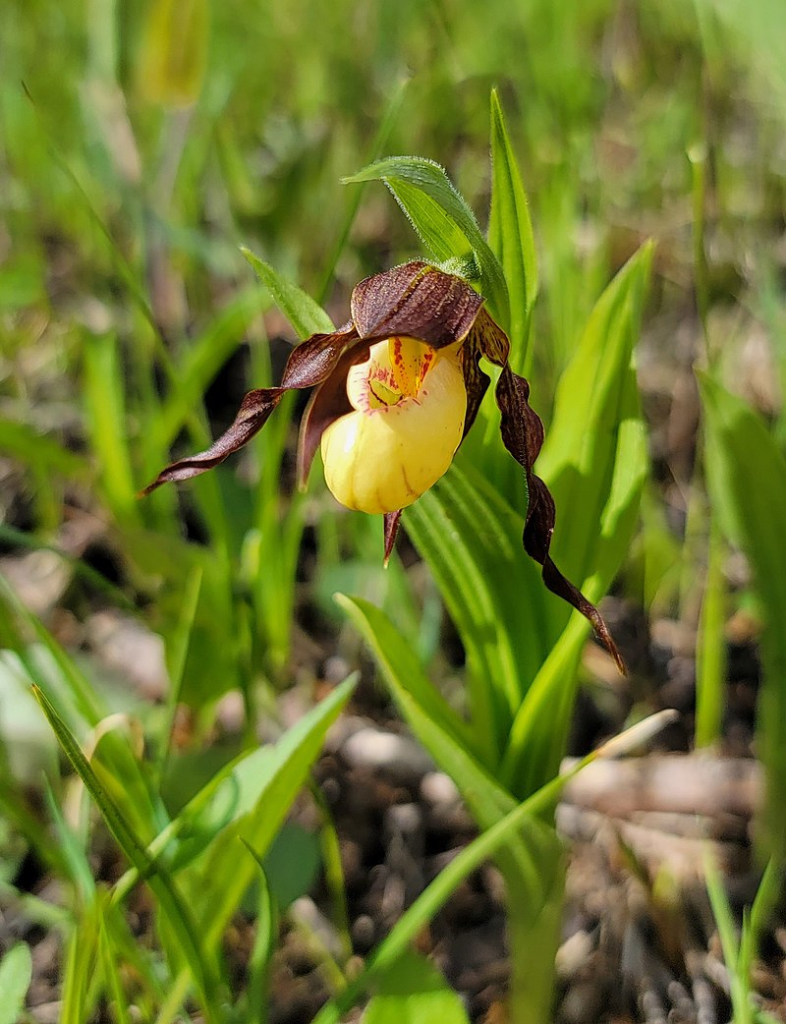
Two to five green leaves are hairy, somewhat elliptic, 2-8″ long, folded lengthwise and are strongly ribbed. They are carried on stems topped with one to two flowers with twisted purple-brown sepals and petals and a brown-striped creamy white pouch that is .5-2.4″ long and fades to yellow with maturity.
Alternate Name/s: None
Native Range: Kentucky as well as parts of the Midwest and Mid-Atlantic
Habitat: Moist prairies, meadows, fens
Type: Perennial
Height: 12-24″
Bloom Time: Late spring to early summer
Bloom Color: White
Light: Sun to dappled shade
Spoil: Humusy, consistently moist, well-drained
USDA Hardiness Zones: 4-8
Photo Credit: Allefant, Wikimedia Commons
White Lady’s Slipper (Cypripedium candida)
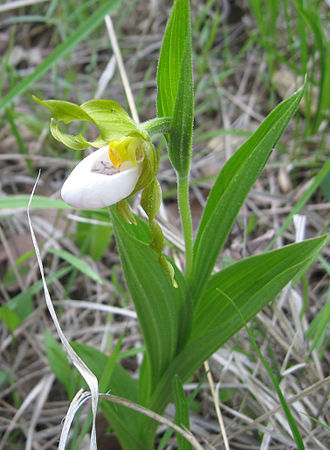
A single plant can have up to 50 stems that carry 3-5 clasping leaves in their upper part and one or two terminal flowers. The leaves are elongated, 2-6″ long, and softly hairy. The flowers have an inflated, ovate pouch that is .5-1″ long, white with a waxy or shiny surface, and often marked with purple stripes inside. The sepals and petals are yellowish green, tan or brown, twisted in spirals, and often spotted with red or purple.
Alternate Name/s: Small white lady’s-slipper
Native Range: Alabama, Kentucky, and Virginia as well as parts of the Midwest and Mid Atlantic
Habitat: Deep-soil mesic prairies, wet prairies, certain types of sedge meadows and calcareous fens
Type: Perennial
Height: 8-14″
Bloom Time: Mid spring to mid summer
Bloom Color: White
Light: Full sun
Soil: Fertile, moderately moist to wet, well-drained
USDA Hardiness Zones: 3-6 (7 if ground cool)
Photo Credit: Wikipedia
Kentucky Lady’s Sipper (Cypripedium kentuckiense)
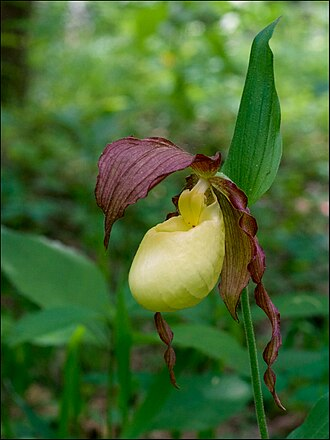
Stems up to 30″ tall carry 2-9 clasping leaves that are up to 7″ long, elongated, and pleated. The single terminal flower has a large, showy, cream to pale yellow pouch 1.8 to 2.6″ long, two downward twisting greenish purple mottled petals up to 4′ long, and three purplish-brown sepals with wavy edges. This orchid has the largest flower of any lady’s slipper.
Alternate Name/s: Southern Lady’s Slipper
Native Range: Louisiana, Arkansas, Mississippi, Alabama, Georgia, Tennessee, Kentucky, and Virginia as well as parts of the Southwest
Habitat: Low lying moist areas in deciduous forests and woodlands
Type: Perennial
Height: 6-30″
Bloom Time: Mid-spring to early summer
Bloom Color: Cream to pale yellow
Light: Part to full shade
Soil: Fertile, medium moist to wet, well-drained
USDA Hardiness Zones: 3-7
Photo Credit: Wikipedia
Greater Yellow Lady’s Slipper (Cypripedium parviflorum)
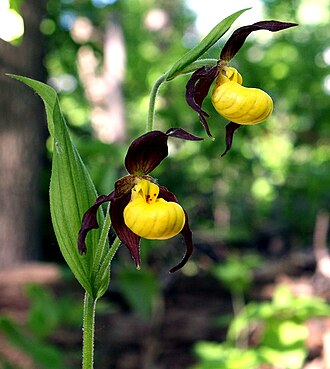
Hairy stems carry 2-5 clasping leaves that are 1.5- 6.5″ long, elliptical to oval, hairy, and have distinct parallel veining. One to two terminal flowers have a pale to dark yellow pouch (rarely white) that is .75-1.25″ long and may have reddish to purplish spots on the pouch opening and faint purple venation on its lower area. Green, yellowish, or dark purple/brown sepals and petals are 2″ long and usually spirally twisted. Yellow lady’s slipper is one of the easier ones to grow so is a good choice for native plant, woodland, shade, meadow, prairie, and pollinator gardens.
Alternate Name/s: Yellow lady’s slipper, lesser yellow lady’s slipper, moccasin flower
Native Range: Virginia, West Virginia, North Carolina, South Carolina, Georgia, Alabama, Mississippi, Arkansas, Kentucky, and Tennessee as well as places on the Pacific Coast, Rocky Mountain area, Southwest, Midwest, Mid-Atlantic and New England
Habitat: Dry to mesic forests, woodlands, fens, prairies, meadows and along streams.
Type: Perennial
Height: 6-17″
Bloom Time: Late spring to early summer
Bloom Color: Yellow
Light: Part shade
Soil: Compost, medium moist, well-drained, acidic
USDA Hardiness Zones: 3-8
Photo Credit: Wikipedia
Large White Lady’s Slipper (Cypripedium reginae)
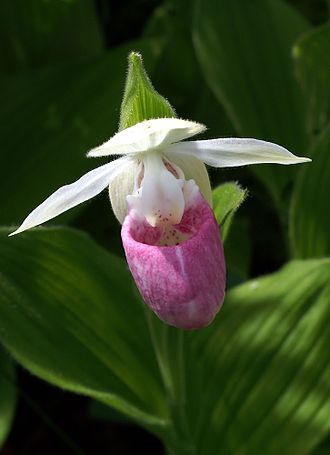
A single plant can produce 20 stems or more (up to 200) and each stem carries 4-12 clasping leaves and 1-3 terminal flowers. The bright green oval leaves are 5- 10″ long, hairy and have wavy edges and prominent longitudinal veining. The flowers have an inflated pouch that is 1-2″ long and white heavily tinted with rose pink to magenta (sometimes all white).The petals and sepals are white, oblong, 2″ long, and finely hairy.
Alternate Name/s: Pink-and-white lady’s-slipper, queen’s lady’s-slipper, fairy queen, white wing moccasin, royal lady’s slipper, and silver-slipper
Native Range: Arkansas, Tennessee, Kentucky, North Carolina, Virginia, and West Virginia as well as areas in the Midwest, Mid Atlantic, and New England
Habitat: Damp fens, meadows, deciduous forests, swamps, along river banks and on rocky outcrops with adequate soil
Type: Perennial
Height: 2-3′
Bloom Time: Late spring to mid summer
Bloom Color: Pink, white
Light: Part shade
Soil: Fertile, humus rich, consistently moist, well-drained
USDA Hardiness Zones: 2-7
Photo Credit: Wikipedia
The Southeast includes Virginia, West Virginia, North Carolina, South Carolina, Georgia, Alabama, Mississippi, Louisiana, Arkansas, Kentucky, Tennessee, and Florida. Most of these states are characterized by hot, humid summers and cool to mild winters, with Florida’s tip being tropical. Summers are generally hot and humid throughout the entire region. Precipitation is abundant in the area and comes mostly in the form of rain.