
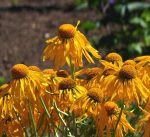
Also known as owl’s claws, this clump-forming perennial a member of the aster family, Asteraceae, that also includes daisy, yarrow and lettuce. It is native to western United States from the Rocky Mountains to California and Oregon where it is found at moderate elevations on moist slopes and well-drained meadows. Plants grow 2-4′ tall and have a taproot and branched stems that are fuzzy when young but smooth when mature. The gray-green leaves are entire, oblanceolate and 12″ long below, more narrow and reduced above. Clusters of 3-8 flowerheads appear in early summer and are 3″ wide. Each flowerhead consists of a center of tiny orange disc flowers surrounded by 14-26 yellowish orange or deep gold ray flowers that are strap-shaped and slightly reflexed. The flowerheads are attractive to butterflies and other pollinators, and are excellent cut flowers. A good choice for borders and butterfly, wildflower, native plant, cottage, meadow, and cutting gardens. The leaves, flowers, and seeds are poisonous to humans and livestock. The genus name, Helenium, honors the ancient Greek legendary character Helen of Troy whose tears are said to have given rise to the plants. The specific epithet, hoopesii, honors Josiah Hoopes, 19th century American botanist and seedsman. The common name, sneezeweed, comes from the fact that the disc flowers and leaves were dried and used as snuff
Type: Herbaceous perennial
Bloom: Flowerheads with orange disc flowers surrounded by yellowish orange to deep gold 2-4′ H x 1.5′ W
Light: Full sun, part shade
Soil: Average, moist, well-drained
Hardiness: Zones 3-9; less heat tolerant that other Helenium species
Care:May need staking
Pests and Diseases: None of significance
Propagation: Seed
Companion Plants: Crocosmia ‘Lucifer’, Verbena conariensis, Russian sage